• Skip to primary navigation
  • Skip to main content
  • Skip to primary sidebar
  • Home
  • Meet Our Team
  • About OT
  • Evaluations & Services
  • Testimonials
  • Blog
  • Books
    • Email
    • Facebook
    • Instagram
    • Phone

Building Blocks Pediatric Occupational Therapy Services

Fairfield Connecticut Occupational Therapist

203-341-0178
943 Post Rd E Suite A
Westport, CT 06880
bbpedot@yahoo.com
  • Home
  • Meet Our Team
  • About OT
  • Evaluations & Services
  • Books
  • Testimonials
  • Blog
    • Email
    • Facebook
    • Instagram
    • Phone

Fine Motor Developmental Milestones

October 23, 2021 By admin

Fine motor skills give us the ability to coordinate and make movements using the small muscles in our hands and wrists. These skills develop as we progress through the stages of human development.
Babies are initially not able to make small movements with their hands but are observed to make wide movements with their arms using larger muscles. In the first 3 months, an infant interacts using their eyes more than their hands, as they visually track objects and people.

Below is an outline of what is expected in typical developmental progression of fine motor skills.

Age: Birth-6 months

  • Follows moving person using their eyes.
  • Ineffective reach for objects and difficulty combining reach and grasp (3 months).
  • Develops ability to accurately and directly reach for objects.
  • Uses crude palmar grasp to grab objects (4-5 months).
  • Transfers objects from hand to hand.
  • Plays with hands at midline (imaginary line that runs down middle of body)
  • Uses palmar grasp where object is secured in the center of the palm (5-6 months).
  • Demonstrates controlled reach and grasp with two hands by 6 months.
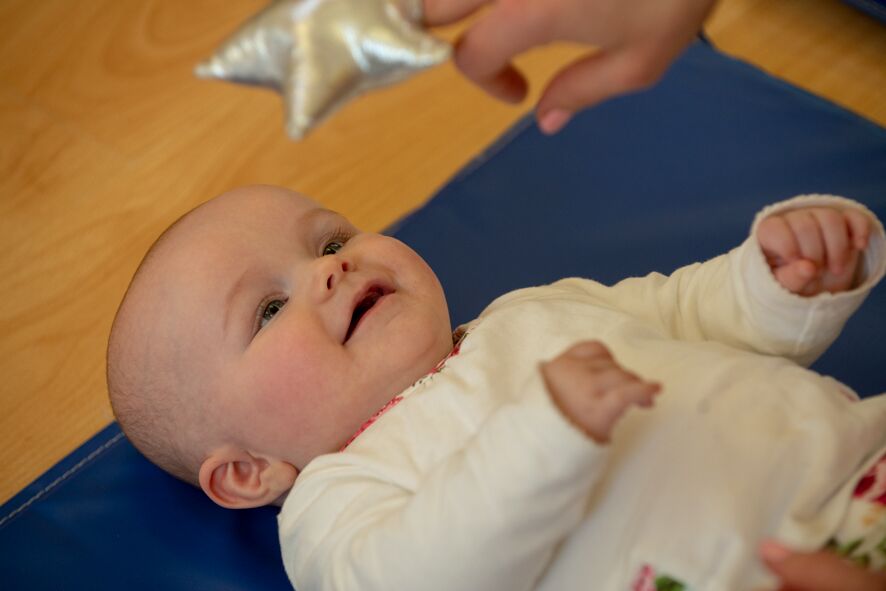
Infant visually tracking object.

Infant’s ability to reach accurately towards objects improves over time.


Crude palmar grasp seen at 4-5 months.

Palmar grasp seen at 5-6 months.

Age: 6 – 12 months

  • Reaches for, grasps, and puts object in mouth.
  • Uses radial palmar grasp where object is secured in the palm, closer to the thumb (6-8 months).
  • Plays with toys at midline and transfers toy from hand to hand.
  • Bangs objects together to make sounds.
  • Waves toys in the air.
  • Uses raking grasp where objects are brought into the palm by flexing fingers in a “raking” motion (7-8 months).
  • Controlled release of toys into container.
  • Uses radial digital grasp where object is secured and held by fingers and opposing thumb (8-10 months).
  • Pincer grasp is observed where there is full opposition of the pad of thumb and index finger in order to hold the object (10-12 months).

Grasping and bringing objects to the midline.

Radial palmar grasp develops around 6-8 months.


Radial digital grasp develops around 8-10 months.

Inferior pincer grasp and neat pincer grasp.


Age: 12-18 months

  • Holds crayon to make marks and scribbles using palmar supinate or fisted grasp, where movement is seen in shoulder and elbow.
  • Points to pictures with index finger.
  • Attempts puzzles.
  • Opens and shuts toy boxes or containers.
  • Uses two hands in play, one to hold or stabilize and the other hand to manipulate toy.

Palmar supinate grasp used to make scribbles.
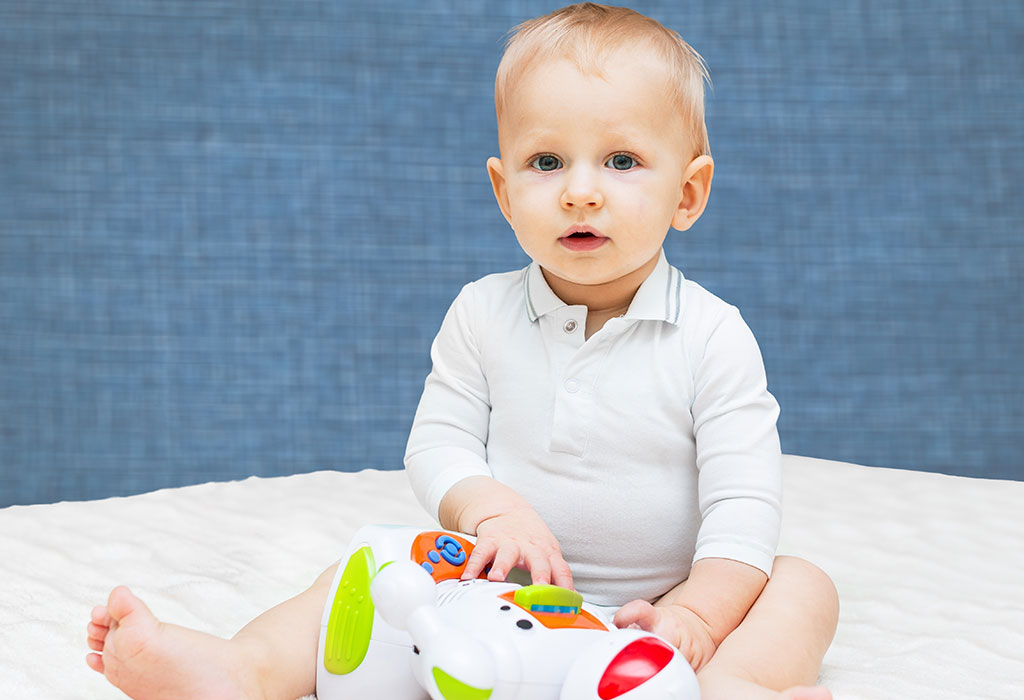
Use of two hands during play.


Age: 18-24 months

  • Completes four- to five- piece puzzle.
  • Builds tower of four small blocks.
  • Holds crayon in fingertips and draws simple figures.
  • Strings beads.
  • Turns pages of book two or three at a time.

Completing simple puzzle.

Stacking blocks requires hand eye coordination and fine motor dexterity.


Age: 2-3 years

  • Snips paper with scissors.
  • Imitates vertical, horizontal, and circular strokes.
  • Holds crayon using a digital pronate grasp.
  • Uses one hand consistently in the majority of activities.
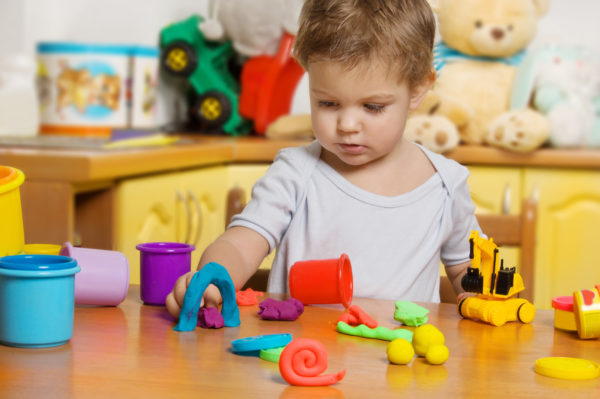
  • Rolls, squeezes and pulls playdough.
  • Turns single pages of a book.

Digital pronate grasp is used at around 2-3 years old.

Using scissors to snip paper.


Age: 3-4 years

  • Builds tower of nine small blocks.
  • Uses static tripod grasp where crayon or marker is held between thumb and index fingers, while resting on the knuckle of the middle finger. Movement still comes from the elbow and shoulder.
  • Copies vertical, horizontal, and circular forms.
  • Imitates cross form.
  • Manipulates clay to roll into balls and “snakes”.
  • Uses non-dominant hand to stabilize and assist during tasks.
  • Constructs 3-D design such as a three-block bridge.
  • Initially cuts jagged snips across a piece of paper which transitions to cutting across straight and curved lines when given a thick guideline.
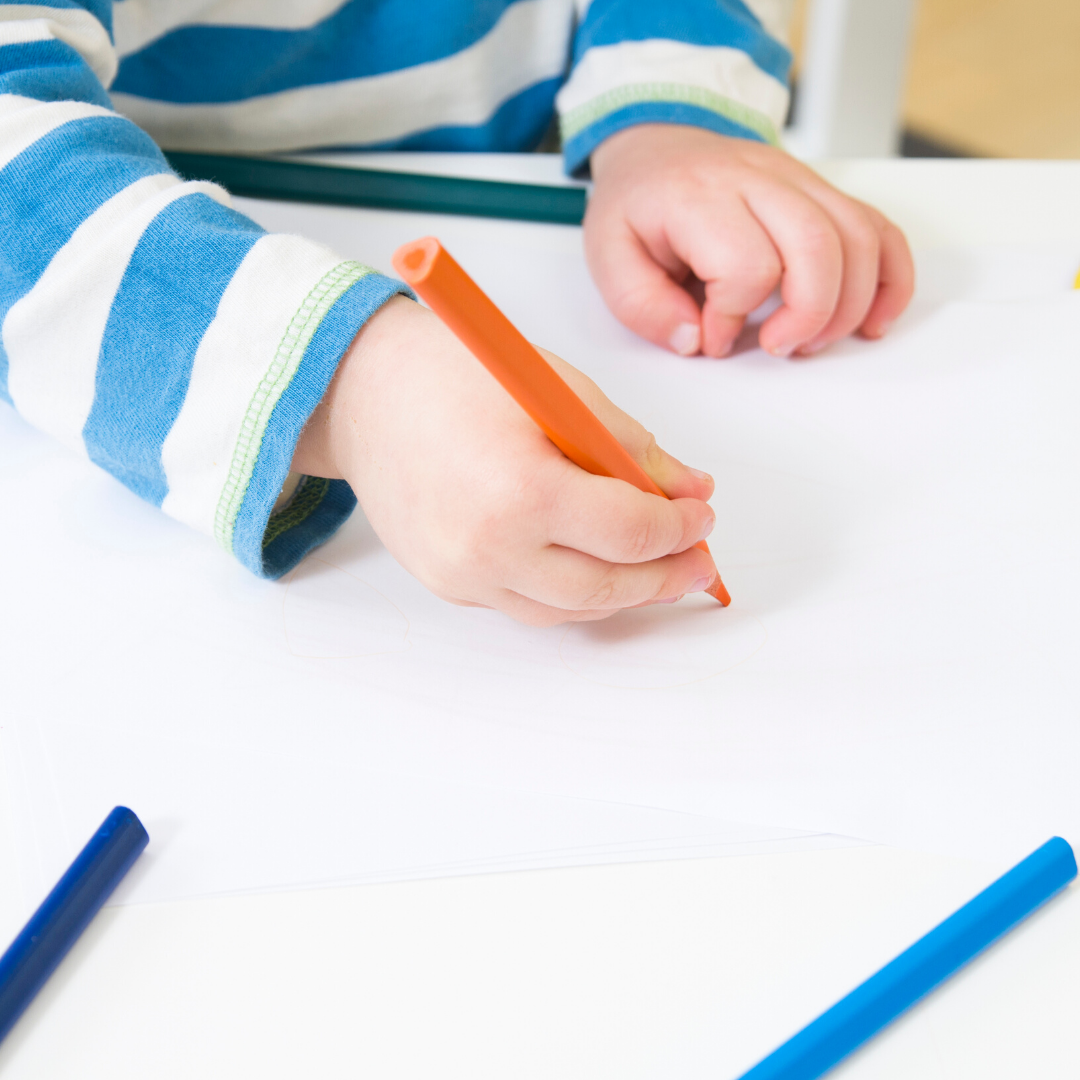
Static tripod grasp, where movement comes from shoulder and elbow.

Age: 4-5 years

  • Begins to draw using a dynamic tripod grasp, with movement initiated from the thumb, index and middle finger, as well as the wrist.
  • Copies simple shapes such as a cross, square and diagonal lines.
  • Completes puzzles of up to 10 pieces.
  • Starts to cut out shapes (squares and triangles) while using helper hand to hold paper.
  • Colors within the lines.
  • Draws a human figure with 4-7 features.
  • Hand dominance becomes well established.

Dynamic tripod grasp.
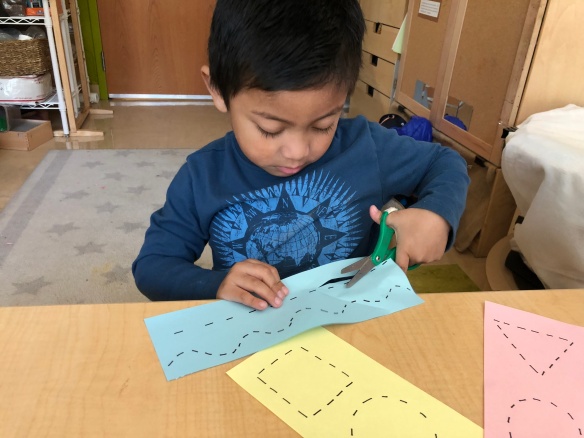
Cutting out various forms while using helper hand to stabilize paper.

Age: 5-6 years

  • Copies shapes such as triangle and “X” form.
  • Completes puzzles of up to 20 pieces.
  • Traces letters, begins to copy letters.
  • Copies letters in own name.
  • Uses two hands together in complementary movements.
  • Draws a human figure with 8-11 features.

Completing puzzle.
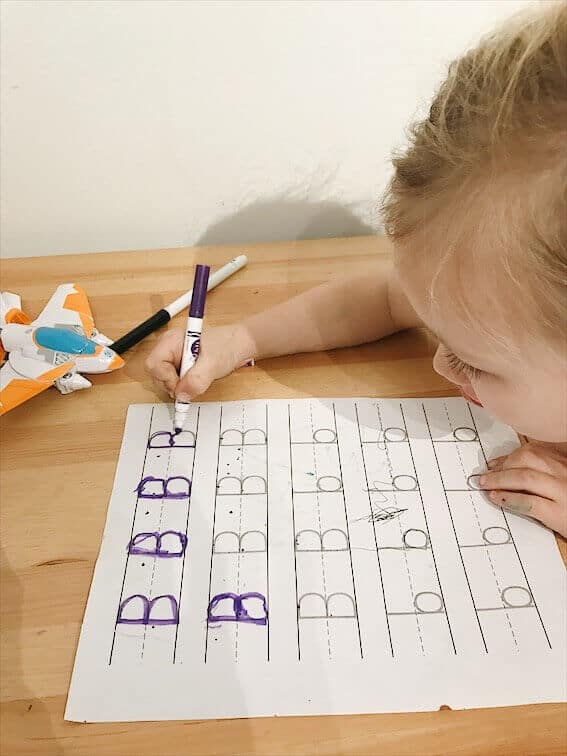
Child learning how to write letters through tracing.

Age: 6-10 years

  • Demonstrates good dexterity and bilateral coordination when creating crafts and constructing with small objects.
  • Can independently build with Legos.
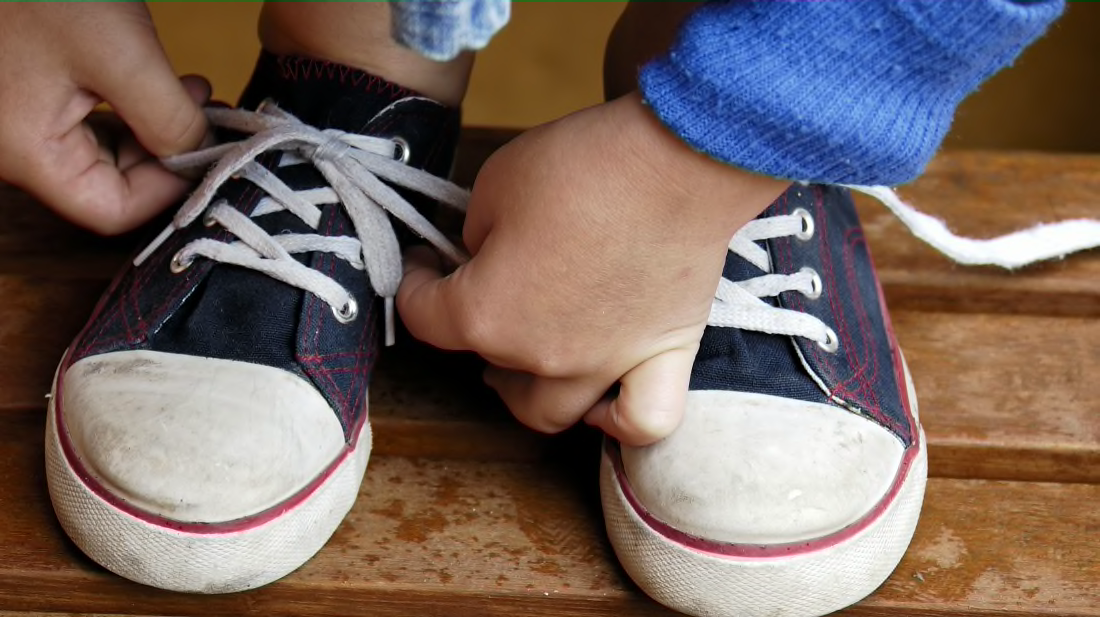
  • Ties shoelaces independently.
  • Handwriting becomes more legible.


Filed Under: Uncategorized

Primary Sidebar

Latest Posts

The Peanut Ball: More Than Just a Ball

What are the Visual Perceptual Skills?

My OT Journey

One Pencil, Many Grips

Like Us on Facebook

Building Blocks Pediatric Occupational Therapy Services, LLC

Archives

Categories

More About Us

  • Home
  • Meet Our Team
  • About Occupational Therapy
  • Evaluations & Services
  • Contact Us
  • Blog
Wondering what happens during an occupational ther Wondering what happens during an occupational therapy session? 
What Is OT and What Will I Do There? was written to help take the mystery out of pediatric occupational therapy. Whether your child is preparing for their very first OT visit or you’re a parent, teacher, or therapist looking for a simple way to explain what OT is, this book makes it easy to understand.
Children will discover that OT is so much more than play. Every swing, obstacle course, craft, game, and activity has a purpose, helping build the skills needed for everyday life, including fine motor skills, sensory processing, self-care, emotional regulation, visual motor integration, and confidence.
My goal is to help children feel excited about therapy and help families understand the “why” behind everything we do. ❤️
Have you ever wondered what OT is all about?
#OccupationalTherapy #PediatricOT #ChildDevelopment #SensoryIntegration #ᴇxᴘʟᴏʀᴇᴘᴀɢᴇ
The Wilbarger Deep Pressure & Proprioceptive Techn The Wilbarger Deep Pressure & Proprioceptive Technique (DPPT)
Also known as the Wilbarger Brushing Protocol

The Wilbarger Protocol is a sensory-based OT intervention that provides deep pressure and proprioceptive input to help organize the nervous system, improve body awareness, and reduce tactile defensiveness.

Who may benefit?
• Tactile defensiveness
• Clothing or grooming sensitivities
• Emotional dysregulation
• Attention and transition difficulties
• Sensory seeking or avoiding behaviors
• Some children with sensory processing differences, ADHD, autism, or developmental delays

Brushing
🖐️ Firm, even pressure
• Brush proximal to distal
• No back-and-forth brushing
• Long, smooth strokes
• Keep the brush flat against the skin
• Brush arms, hands, back, legs, and feet only
🚫 Never brush the face, chest, stomach, or groin

Joint Compressions
🤲 Immediately follow brushing
• Support the limb
• Keep joints neutral
• Compress gently through the joint
• Never twist, pull, or force a joint

Benefits
✅ Better regulation
✅ Improved attention
✅ Increased body awareness
✅ Reduced tactile defensiveness
✅ Greater participation in daily activities

DPPT should only be taught and supervised by a trained occupational therapist and is individualized for every child.

💙 Helping children feel regulated, confident, and successful.

#OccupationalTherapy #ᴇxᴘʟᴏʀᴇᴘᴀɢᴇ #SensoryProcessing #Brushing #WilbargerProtocol
It may look like a simple puzzle, but this activit It may look like a simple puzzle, but this activity is doing so much more!

Lying on a peanut ball helps build core and shoulder strength, postural control, and visual motor skills, all through play.

Want to learn why the peanut ball is one of our favorite OT tools? Read our latest blog. Link in bio!

#PediatricOT #OccupationalTherapy #explorepages #ChildDevelopment #PlayBasedLearning
As a pediatric occupational therapist, I often tal As a pediatric occupational therapist, I often talk about going deeper than just “take a deep breath.” Deep breathing is more than a simple instruction—it’s a powerful tool that helps children connect with their bodies, regulate their emotions, and calm their nervous systems.
One of my favorite ways to teach this is with a breathing ball. It’s simple, colorful, and engaging, giving children a visual and hands-on way to understand what’s happening inside their bodies.
As you slowly open the ball, encourage your child to take a slow, deep breath in through their nose, imagining their lungs filling up just like the ball expands. This helps them become aware of how their body feels when they breathe in.
Then, as you slowly close the ball, have them gently blow all the air out through their mouth until their “chipmunk cheeks” are completely empty. Encourage them to keep blowing until every last bit of air is out. This full exhale is just as important as the inhale—it helps release tension and signals the body to relax.
Repeat this several times. The movement of the ball helps children pace their breathing and stay focused, making it much easier than simply telling them to “take a deep breath.” Over time, this builds body awareness, supports self-regulation, and helps children learn how to calm themselves when they feel overwhelmed.
This is an easy strategy to use at home, in the classroom, before homework, before bed, or anytime a child is feeling anxious, frustrated, or needs a reset.
Sometimes the simplest tools can make the biggest difference. 💙
#ᴇxᴘʟᴏʀᴇᴘᴀɢᴇ  #SelfRegulation #DeepBreathing #Sensory #Interoception
Sometimes the most meaningful therapy doesn’t lo Sometimes the most meaningful therapy doesn’t look like “therapy” at all.
Through play, children are building the foundational skills they need for everyday life. During this activity, we’re targeting balance, core strength, coordination, motor planning, bilateral coordination, visual tracking, and postural control—all while keeping therapy engaging and fun.
Play isn’t a break from learning. For children, play is learning.
#OccupationalTherapy #PediatricOT #OT #ᴇxᴘʟᴏʀᴇᴘᴀɢᴇ #ChildDevelopment
Did you know that visual perception is about so mu Did you know that visual perception is about so much more than eyesight? 👀

Visual perception is the brain’s ability to make sense of what the eyes see. These skills play a huge role in everyday activities like reading, handwriting, completing puzzles, finding items in a backpack, and even getting dressed.

Swipe through to learn:
✨ What visual perception is
✨ The 7 visual perceptual skills
✨ How these skills impact daily life
✨ How occupational therapy can help

Want to learn more? Our newest blog takes a deeper dive into visual perception and how OT supports these important skills. Check out the link in our bio!

#PediatricOT #OccupationalTherapy #VisualPerception #VisualPerceptualSkills #ᴇxᴘʟᴏʀᴇᴘᴀɢᴇ
My journey to find occupational therapy may have t My journey to find occupational therapy may have taken a bit longer than others, but I 'm grateful for each experience that got me to where I am today!

For those who don't know me, my name is Colleen McGuinness and I have been completing my fieldwork rotation at Building Blocks Pediatric Occupational Therapy as an OT student for the past 3 months. So before I go, I want to tell you about my journey into OT!

Check out our latest blog post using the link in our bio to read more about my journey into OT!

#OTStudent #JourneytoOT #PediatricOT #ᴇxᴘʟᴏʀᴇᴘᴀɢᴇ @nbcot @aotainc
✏️ Not sure which pencil grip is right for you ✏️ Not sure which pencil grip is right for your child?

Each pencil grip is designed to support different needs, and choosing the right one can make writing more comfortable and efficient. Check out this quick overview, then head to the blog (link in bio) to learn more about each grip and how to choose the best fit!

#OccupationalTherapy #PediatricOT #FineMotorSkills #ᴇxᴘʟᴏʀᴇᴘᴀɢᴇ pencilgrips
Follow on Instagram

Copyright © 2026 · BBPOTS, LLC · Site Design by Little Blue Deer
Privacy Policy