What is executive function?
Executive function is a combination of high-level mental skills that manage one’s ability to utilize cognitive abilities in order to carry out goals. Each individual’s executive functioning abilities can affect their success within the home, school, work, and social situations.
What are the basic areas of executive function?
1. Working memory
-
- The ability to hold a small amount of information in the mind while using that information to execute a cognitive task
- Cognitive tasks that involve working memory include:
- Following a multi-step set of verbal instructions
- Mental math or doing math “in your head”
- Processing verbal information and responding in conversation
- Reading comprehension
2. Cognitive flexibility
-
- The ability to cognitively respond to changes in task or environment
- Cognitive flexibility allows individuals to think about one idea or problem in multiple ways, think about multiple ideas at once, and switch between thinking about separate concepts
- Mental processes that involve cognitive flexibility include:
- Metacognition: the ability to think about and reflect on one’s own thinking
- Emotional regulation
- Empathizing with others
- “Brainstorming” a problem
3. Inhibitory control
-
- The ability to control automatic or impulsive responses
- Tasks that require inhibitory control include:
- Ignoring irrelevant sounds and other stimuli while focusing on an exam
- Thinking before you speak or stopping oneself from “blurting out” thoughts
- Refraining from eating unhealthy foods while on a diet
- Stopping oneself from checking social media or text messages while working on a project
What are the 8 main executive functioning skills?
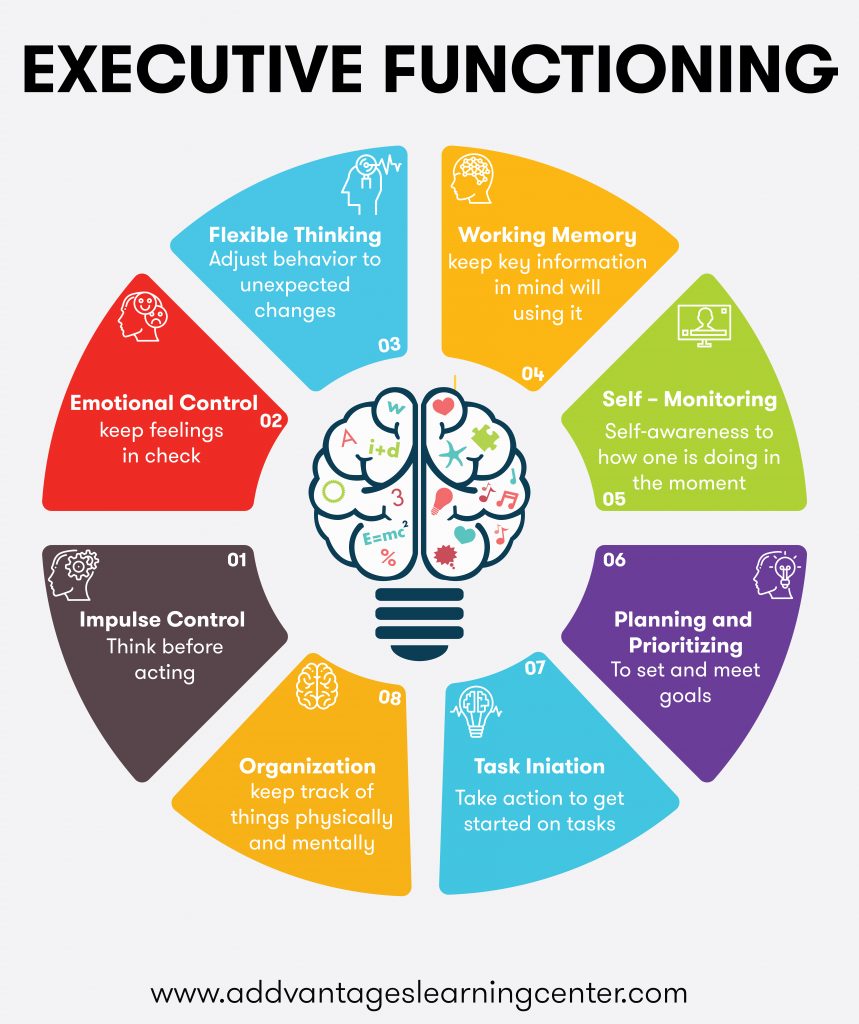
As discussed above, executive functioning can be divided into three basic areas: working memory, cognitive flexibility, and inhibitory control. However, there are eight main executive functioning skills that fall under the three basic areas.
1. Impulse Control
- The ability to think and control one’s behavior before responding
2. Emotional Control
- The ability to manage and regulate emotions as well as emotional responses
3. Flexible Thinking
- The ability to mentally respond to changes in task or environment
4. Working Memory
- The ability to remember a small amount of information while executing a cognitive task
5. Self-Monitoring
- The ability to evaluate one’s own performance
6. Planning and Prioritizing
- The ability to organize the steps necessary to achieve a goal
7. Task Initiation
- The ability to begin a task without getting “stuck”
8. Organization
- The ability to monitor and coordinate physical objects or mental processes

Executive Functioning Difficulties:
The following are signs that one may be struggling with executive functioning:
- Difficulty initiating tasks or initiating multiple tasks without completing them
- Trouble “prioritizing” tasks or figuring out which tasks are most important to complete
- Forgetting information shortly after hearing or reading it
- Getting distracted easily
- Difficulty following multi-step directions
- Trouble controlling impulses
- Inflexibility with changes in routines or rules
- Difficulty switching tasks while maintaining focus
- Trouble with multi-tasking
- Difficulty managing emotions and a tendency to “ruminate” on emotions
- Losing or misplacing belongings
- Difficulty arriving on time or estimating the length of time to complete a task
- Difficulty organizing one’s thoughts
What causes executive functioning difficulties?
Trouble with executive functioning can have multiple causes and is associated with various diagnoses.
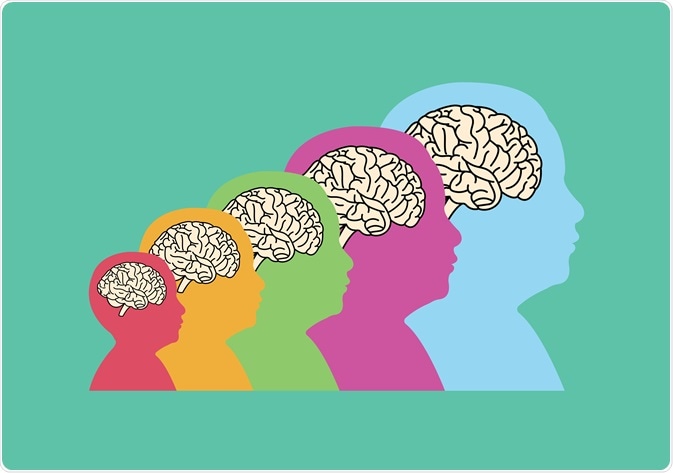
1. Brain Development
- Slower development in certain areas of the brain is associated with executive functioning challenges
- The prefrontal cortex, located in the frontal lobe of the brain, is the primary area of the brain associated with executive functioning skills. However, slower or less efficient neural pathways to other areas of the brain may cause executive functioning challenges as well.
2. Genetics
- Difficulties with executive functioning tend to run in families
3. ADHD
- Attention-Deficit/Hyperactivity Disorder (ADHD) is a diagnosis associated with executive functioning challenges
4. Learning disabilities
- Difficulties with executive functioning can cause challenges with reading and math
- Individuals with learning disabilities such as dyslexia and dyscalculia often also exhibit challenges with executive functioning
4. ASD
- Individuals with autism spectrum disorder (ASD) often exhibit challenges with executive functioning due to differences in brain development
5. Mental Illnesses
- Mental illnesses such as depression and PTSD are associated with executive functioning challenges
6. TBI and Stroke
- Traumatic brain injuries (TBIs) and strokes may cause damage to the areas of the brain that control executive functioning and lead to challenges
7. Alzheimer’s Disease
- Alzheimer’s Disease leads to degeneration and damage in multiple areas of the brain including areas associated with executive functioning skills