• Skip to primary navigation
  • Skip to main content
  • Skip to primary sidebar
  • Home
  • Meet Our Team
  • About OT
  • Evaluations & Services
  • Testimonials
  • Blog
  • Books
    • Email
    • Facebook
    • Instagram
    • Phone

Building Blocks Pediatric Occupational Therapy Services

Fairfield Connecticut Occupational Therapist

203-341-0178
bbpedot@yahoo.com
  • Home
  • Meet Our Team
  • About OT
  • Evaluations & Services
  • Books
  • Testimonials
  • Blog
    • Email
    • Facebook
    • Instagram
    • Phone

Handwriting: Tips & Tricks for Letter Spacing and Sizing

January 21, 2020 By admin

Handwriting: Tips & Tricks for Letter Spacing and Sizing

Letter sizing is a skill that should be refined over time as a child’s development grows.

Tips and Tricks: 

  • Use individual boxes for each letter:
    • Having a box for each individual letter allows the child to have a “visual boundary” while writing
    • If the child has limited experience manipulating a crayon or marker, they tend to use larger motor movements coming from the elbow or shoulder, instead of dynamic wrist movements
    • By providing a box for each letter this will encourage them to begin refining their sizing (boxes should be 3”x3” for a novice writer decreasing as their fine motor control develops)

  • Review tall/starting at plane or tallest line on writing paper, small/letters beginning at the midline of the writing paper, and falling/sinking letters going to the worm line of the writing paper:
    • Using visual representations helps children to discriminate between the different line boundaries
    • Falling letters example: these letters hang below the line like a monkey (g, j, p, q)

  • Fundations writing paper: many schools use this paper as it coincides with Wilson’s reading program (sky, plane, grass, and worm line)

  • Progress to large boxes for whole words:
    • As letter sizing improves, offer the children rectangular boxes for them to size their words within a designated width
    • It allows them to rely on their letter sizing judgement

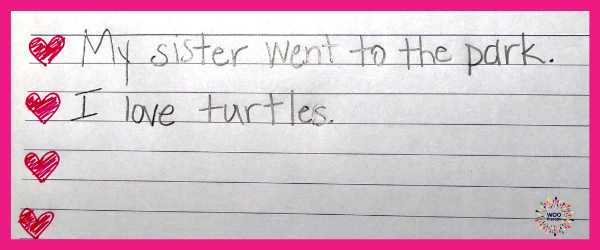
  • Provide a picture or sticker for reference:
    • Draw or place a simple image or sticker (heart, star, frog, etc) as a visual starting point for the writer and visual feedback so they can see if their letter sizing matches the size of the visual aid
    • you can begin each writing line with a verbal prompt, “Make your letters the same size as the star.”
  • Ice cream writing paper: letters begin at the strawberry ice cream line, midline letters begin at the vanilla ice cream line, and sinking letters fall below the chocolate ice cream line

  • Handwriting Without Tears paper examples:
    • Shows wear letters should begin

  • Use imagery to represent each line on the paper:
    • Using visual and verbal prompts to explain to the child that the top line is the sky and the bottom line is the grass line (i.e. letter g grows down into the grass).
    • Examples: skyline, plane line, grass line, worm line

  • Use colored line:
    • Color-coded lines to represent top, mid, and baselines and pair the visual cue with a verbal cue to support the child

  • Size Matters Handwriting Program:
    • Provides clear instructions, visual cues, magnetic manipulatives, and verbal language to support properly sized letters for all uppercase and lowercase letters
    • This program comes with a student workbook, dice game, desktop stickers, letterbox stickers, activity books, and more



Filed Under: FAQ, Therapy

Primary Sidebar

Latest Posts

My OT journey

🌈 Social and Emotional Skills in OT: “What is OT? Series Book 7 

🌀Sensory Skills in OT: “What Is OT?” Series Book 6

🏠 Life Skills in OT: “What Is OT?” Series Book 5

Like Us on Facebook

Building Blocks Pediatric Occupational Therapy Services, LLC

Archives

Categories

More About Us

  • Home
  • Meet Our Team
  • About Occupational Therapy
  • Evaluations & Services
  • Contact Us
  • Blog
📚 The What Is OT? Book Series By Justine “Jel 📚 The What Is OT? Book Series
By Justine “Jellybean” Bedocs

✨ A seven-book children’s series created to explain Occupational Therapy in a fun, simple, and meaningful way.

These books help children understand what OT is and how it helps them grow, learn, regulate, and gain confidence in everyday life. Perfect for therapists, teachers, parents, and caregivers to use at home, in schools, or in therapy sessions.

⸻

🌟 The Seven Books in the Series

📗 Book 1: What Is OT? What Will I Do There?
An introduction to occupational therapy and how it helps kids succeed every day.
👉 https://a.co/d/16Ql977

📘 Book 2: Hand Skills in OT
Focuses on fine motor skills like writing, cutting, buttoning, and strengthening little hands.
👉 https://a.co/d/7matwO8

🧠 Book 3: Brain and Body Skills in OT
Explains how the brain and body work together for focus, coordination, and regulation.
👉 https://a.co/d/f4Rwx8R

📗 Book 4: Eye and Hand Skills in OT
Covers visual motor and visual perceptual skills used for reading, writing, and play.
👉 https://a.co/d/5N2jD0p

📙 Book 5: Life Skills in OT
Highlights independence with dressing, feeding, routines, and daily living skills.
👉 https://a.co/d/aEGa8B5

📘 Book 6: Sensory Skills in OT
Helps children understand sensory processing and how to feel calm, focused, and regulated.
👉 https://a.co/d/if6K8f9

🌈 Book 7: Social and Emotional Skills in OT
Teaches emotional awareness, coping skills, confidence, and social connection.
👉 https://a.co/d/0bCHcTu

⸻

✨ These books are designed to help children feel confident, understood, and supported while helping parents and professionals explain OT in a simple and meaningful way.

📚 Full collection here:
👉 https://connecticutoccupationaltherapist.com/books/

Thank you for supporting this project and for sharing with families, educators, and therapists who may benefit 💛
— Justine Bedocs, OTR/L
Westport, Connecticut
Check out my final blog post about my OT journey a Check out my final blog post about my OT journey as a student with the link tagged in our bio! 🤗 💜#occupationaltherapystudent #nbcot
Had to join in on the Labubu (and Lafufu) craze, i Had to join in on the Labubu (and Lafufu) craze, in a fun fine motor way!🤩🧸🧡 #finemotoractivity #labubu #occupationaltherapy
Blogs of Books 3 and 4 are now live on the website Blogs of Books 3 and 4 are now live on the website. Click the link in bio to learn more about the "What is OT" Book Series and each character in the books!🤩📚 #occupationaltherapy #WhatIsOTBookSeries #westportmoms #pediatrics
Learn more about the different pencil grasps your Learn more about the different pencil grasps your child uses everyday with the link in our bio!✏️💫#occupationaltherapy #buildingblocksoccupationaltherapy #momsofwestport #pediatricot #aota #finemotor
Happy Halloween from Building Blocks Pediatric OT! Happy Halloween from Building Blocks Pediatric OT!🧙👻🧡 #spookyseason #happyhalloween🎃 #pedatricot #67
Prone Play = 💪 Child!! Link in bio to learn mor Prone Play = 💪 Child!! Link in bio to learn more about prone activities and how it can make your child stronger😎 #pediatricoccupationaltherapy #westportct #fun #buildingblocksoccupationaltherapy #otforkids
Bilateral coordination is the ability to use both Bilateral coordination is the ability to use both sides of the body simultaneously in a controlled and organized manner🤲. It supports tasks like writing, playing sports, and even tying your shoes! Link in bio to learn more about the importance of why using both hands matters💥 #occupationaltherapy #selfcaretips #blogpost #westportct #pediatricotlife
Follow on Instagram

Copyright © 2026 · BBPOTS, LLC · Site Design by Little Blue Deer
Privacy Policy