• Skip to primary navigation
  • Skip to main content
  • Skip to primary sidebar
  • Home
  • Meet Our Team
  • About OT
  • Evaluations & Services
  • Testimonials
  • Blog
  • Books
    • Email
    • Facebook
    • Instagram
    • Phone

Building Blocks Pediatric Occupational Therapy Services

Fairfield Connecticut Occupational Therapist

203-341-0178
bbpedot@yahoo.com
  • Home
  • Meet Our Team
  • About OT
  • Evaluations & Services
  • Books
  • Testimonials
  • Blog
    • Email
    • Facebook
    • Instagram
    • Phone

Blog Post 5: Joint Compressions

May 14, 2025 By admin

Definitions to know:

Body awareness: Being conscious and connected to one’s body as in its movements, sensations and position in space. This combines interoception, vestibular and proprioception input. 

Proprioception: Understanding where one’s body is in space.

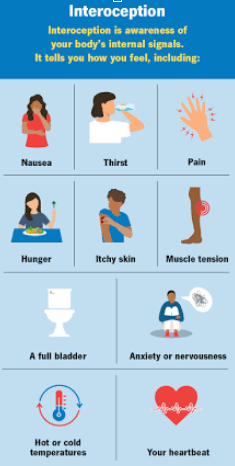
Interoception: Awareness of internal bodily sensations. 
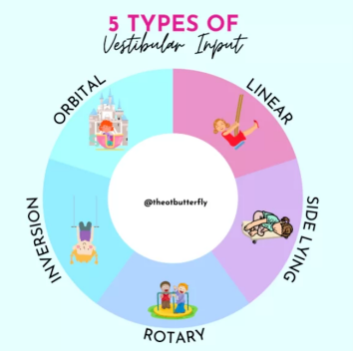
Vestibular: Balance and spatial orientation which helps the body orient through space. 
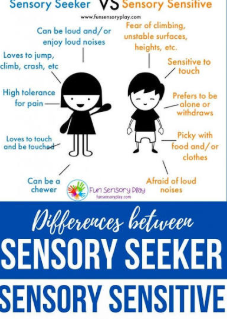
Sensory Seeker: A person that actively seeks out some type of sensory to fulfil a sensory need to regulate themselves. 

Sensory sensitivity: Heightened awareness of certain senses and feeling them more strongly than others which can be dysregulating. 

Tactile defensiveness: Sensory processing sensitivity where the person experiences touch stronger than others which can lead to aversion.


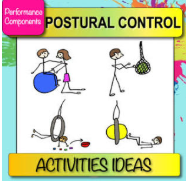
Postural stability: Being able to keep one’s body balanced and controlled when standing or moving to maintain an upright position. Sensory input is required to keep proper position such as visual, auditory, and proprioception input. Postural stability requires strong core muscles and coordination which are also crucial for child development, starting the baseline for gross and fine motor abilities. 


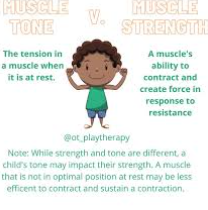
Muscle tone: Resting tension in skeletal muscles and cannot be controlled voluntarily. This is the body’s response to force and helps with reflexes, organ regulation and posture. 
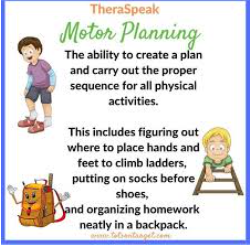
Motor planning: ability to plan and organize one’s body movements
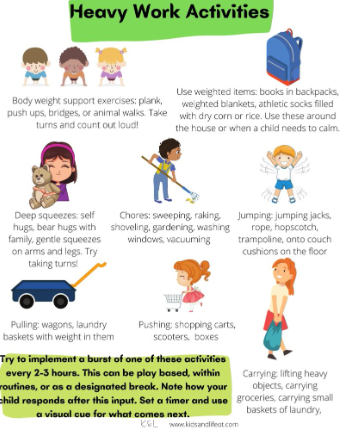
Heavy work: Activities that provide deep pressure and proprioceptive feedback to the child. These activities often include carrying, pushing, or pulling. 
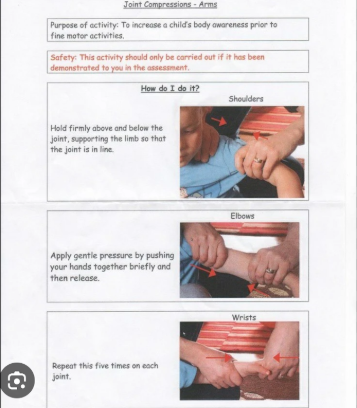
What are Joint Compressions?

Joint compressions are when you push joints together, compressing them, multiple times for a few seconds to provide proprioceptive input. This then promotes body awareness, regulation, postural stability, muscle tone, and motor planning. Joint compressions can also come from heavy work, however it is not as targeted. 
Why does it work?

Often sensory seekers move around to try and fulfil the need of proprioceptive input. This is a structured activity that fills the need, allowing the child to become more regulated and better focused. 


When can/should they be used? 

This should be used for proprioceptive sensory seekers, however, if that child is also tactile defensive, this can become more dysregulating for them. Make sure to know the client’s sensory needs you are working with before utilizing this technique. Sensory sensitive kids may not like this strategy as well since they tend to be more sensitive. When a child is open to a new sensory strategy and how they respond may vary on the day to day so it is good to trial a few times before giving up if they are observed to need that proprioceptive input.

Important to note:

If a child is ever visually uncomfortable or verbally makes uncomfortable sounds or asks to stop, this activity is to be stopped immediately. This activity should be fun/calming and should never be forced on a child. 

In conclusion, joint compressions can be a useful tool to help a child receive that proprioceptive input and regulate. However, it is important to make sure the child is a good candidate for joint compressions and that they are never uncomfortable during the process. If used correctly this can be used in a specific sensory diet (discussed in an earlier post) or it can just be a strategy to use when the child is jumping all around seeking proprioceptive input. 

References: 

Malinakova, K., Novak, L., Trnka, R., & Tavel, P. (2021). Sensory Processing Sensitivity Questionnaire: A Psychometric Evaluation and Associations with Experiencing the COVID-19 Pandemic. International journal of environmental research and public health, 18(24), 12962. https://doi.org/10.3390/ijerph182412962

Morin, A. (n.d.). Sensory seeking and sensory avoiding: What you need to know. Understood. https://www.understood.org/en/articles/sensory-seeking-and-sensory-avoiding-what-you-need-to-know 

Motiwala, R. (2021, May). Muscle tone. Muscle Tone – an overview | ScienceDirect Topics. https://www.sciencedirect.com/topics/medicine-and-dentistry/muscle-tone#:~:text=The%20muscle%20tone%20is%20evaluated%20most%20commonly,judging%20resistance%20to%20passive%20range%20of%20motion. 

Samantha Berger, M. (2024b, November 27). Tactile defensiveness explained + tactile sensory activities: Napa Center. NAPA. https://napacenter.org/tactile-defensiveness/#:~:text=Tactile%20defensiveness%20is%20a%20specific,sensory%20input%20is%20not%20functional. 


Filed Under: Uncategorized

Primary Sidebar

Latest Posts

My OT journey

🌈 Social and Emotional Skills in OT: “What is OT? Series Book 7 

🌀Sensory Skills in OT: “What Is OT?” Series Book 6

🏠 Life Skills in OT: “What Is OT?” Series Book 5

Like Us on Facebook

Building Blocks Pediatric Occupational Therapy Services, LLC

Archives

Categories

More About Us

  • Home
  • Meet Our Team
  • About Occupational Therapy
  • Evaluations & Services
  • Contact Us
  • Blog
📚 The What Is OT? Book Series By Justine “Jel 📚 The What Is OT? Book Series
By Justine “Jellybean” Bedocs

✨ A seven-book children’s series created to explain Occupational Therapy in a fun, simple, and meaningful way.

These books help children understand what OT is and how it helps them grow, learn, regulate, and gain confidence in everyday life. Perfect for therapists, teachers, parents, and caregivers to use at home, in schools, or in therapy sessions.

⸻

🌟 The Seven Books in the Series

📗 Book 1: What Is OT? What Will I Do There?
An introduction to occupational therapy and how it helps kids succeed every day.
👉 https://a.co/d/16Ql977

📘 Book 2: Hand Skills in OT
Focuses on fine motor skills like writing, cutting, buttoning, and strengthening little hands.
👉 https://a.co/d/7matwO8

🧠 Book 3: Brain and Body Skills in OT
Explains how the brain and body work together for focus, coordination, and regulation.
👉 https://a.co/d/f4Rwx8R

📗 Book 4: Eye and Hand Skills in OT
Covers visual motor and visual perceptual skills used for reading, writing, and play.
👉 https://a.co/d/5N2jD0p

📙 Book 5: Life Skills in OT
Highlights independence with dressing, feeding, routines, and daily living skills.
👉 https://a.co/d/aEGa8B5

📘 Book 6: Sensory Skills in OT
Helps children understand sensory processing and how to feel calm, focused, and regulated.
👉 https://a.co/d/if6K8f9

🌈 Book 7: Social and Emotional Skills in OT
Teaches emotional awareness, coping skills, confidence, and social connection.
👉 https://a.co/d/0bCHcTu

⸻

✨ These books are designed to help children feel confident, understood, and supported while helping parents and professionals explain OT in a simple and meaningful way.

📚 Full collection here:
👉 https://connecticutoccupationaltherapist.com/books/

Thank you for supporting this project and for sharing with families, educators, and therapists who may benefit 💛
— Justine Bedocs, OTR/L
Westport, Connecticut
Check out my final blog post about my OT journey a Check out my final blog post about my OT journey as a student with the link tagged in our bio! 🤗 💜#occupationaltherapystudent #nbcot
Had to join in on the Labubu (and Lafufu) craze, i Had to join in on the Labubu (and Lafufu) craze, in a fun fine motor way!🤩🧸🧡 #finemotoractivity #labubu #occupationaltherapy
Blogs of Books 3 and 4 are now live on the website Blogs of Books 3 and 4 are now live on the website. Click the link in bio to learn more about the "What is OT" Book Series and each character in the books!🤩📚 #occupationaltherapy #WhatIsOTBookSeries #westportmoms #pediatrics
Learn more about the different pencil grasps your Learn more about the different pencil grasps your child uses everyday with the link in our bio!✏️💫#occupationaltherapy #buildingblocksoccupationaltherapy #momsofwestport #pediatricot #aota #finemotor
Happy Halloween from Building Blocks Pediatric OT! Happy Halloween from Building Blocks Pediatric OT!🧙👻🧡 #spookyseason #happyhalloween🎃 #pedatricot #67
Prone Play = 💪 Child!! Link in bio to learn mor Prone Play = 💪 Child!! Link in bio to learn more about prone activities and how it can make your child stronger😎 #pediatricoccupationaltherapy #westportct #fun #buildingblocksoccupationaltherapy #otforkids
Bilateral coordination is the ability to use both Bilateral coordination is the ability to use both sides of the body simultaneously in a controlled and organized manner🤲. It supports tasks like writing, playing sports, and even tying your shoes! Link in bio to learn more about the importance of why using both hands matters💥 #occupationaltherapy #selfcaretips #blogpost #westportct #pediatricotlife
Follow on Instagram

Copyright © 2026 · BBPOTS, LLC · Site Design by Little Blue Deer
Privacy Policy