We have so many sensory experiences throughout the day. Some we may like and some we may not, but understanding what and how we have these experiences will help us respond and understand ourselves better. So, let’s explore the 7 senses!
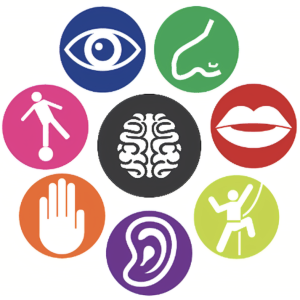
Vision
- This is our ability to gather information about our environment.
- Vision is not only about sight, it also has the important job of interpreting and recognizing what we see.
- Our vision can detect light patterns, color, depth, and movement.
Olfaction (smell)
- This is our sense of smell, which has connections to our emotions, memory, perception of our surrounding.
- Different smells can help to promote relaxation and emotional regulation.
- Smell is also closely linked to taste and can have a large impact on those sensory experiences. Let’s take a look at our sense of taste next!
Gustation (taste)
- Our sense of taste is unique in that it can be shaped by our genetics, culture, and experiences.
- It is important to know that when we are picky or sensitive to certain tastes or food textures it can have a negative impact on our nutrition and social experiences.
- If you have a picky eater at home check out this PBS article with helpful tips on how to get kids to try new foods!
- https://www.pbs.org/parents/thrive/9-tips-to-help-kids-try-new-foods
Audiation
- Our sense of hearing is an important aspect of communication and social interactions.
- This allows us to engage in the world around us through different aspects such as music and language.
Tactile
- Our sense of touch provides important input that can help us stay safe, such as the experience of temperature, texture, and pressure.
- The experience of touch also plays an important role in communication and physical interactions.
Vestibular
- This is our sense of balance, which plays a crucial role in our posture, coordination, and physical movements.
- These sensory experiences can have a great impact on our ability to engage in our daily lives and interact with the environment.
Proprioception
- This is our sense of body position and movement.
- This sense helps our body to know know where our body is without solely relying on our sense of sight.
- Proprioceptive input can also help us to maintain balance in conjunction with our vestibular sense.
We have taken the first step in exploring our senses today by reviewing the importance and roles of our 7 senses. But, did you know there is an 8th sense? Check back next week to learn about our “8th sense,” interoception!
Resources
Doak, R. (2026, January 23). A guide to understanding and supporting your child’s sensory system. scParents. https://scparents.org/blog/a-guide-to-understanding-and-supporting-your-childs-sensory-system/
Heger, E. (2024, April 8). 9 tips to help Kids Try New Foods. PBS. https://www.pbs.org/parents/thrive/9-tips-to-help-kids-try-new-foods
Myers, S. (2024, March 26). Understanding your child’s sensory system: The 7 senses. NAPA. https://napacenter.org/sensory-system/
Proprioception. Cleveland Clinic. (2024, July 25). https://my.clevelandclinic.org/health/articles/proprioception