Pencil grasp can feel like a big deal, especially when your kiddos are first learning to write or when handwriting starts to feel hard and frustrating. In this blog, we will look at the stages of pencil grasp development, what is considered age-appropriate, and when a pencil grasp may actually start to interfere with writing.
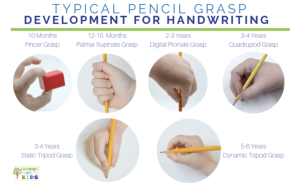
Grasp development follows three main categories: primitive grasps, transitional grasps, and mature grasps. Primitive grasps are characterized by movement coming from the whole arm. Transitional grasps involve movement from the forearm or wrist. Finally, mature grasps allow the child to hold and maneuver the pencil using the small muscles of the hand and fingers.
Before we start, here are some terms and definitions that will help explain the different grasp patterns:
- Radial – Thumb side of the hand
- Digital – Refers to the fingers
- Palmar – Palm side, or the inside of the hand
- Supinate – Palm or forearm facing upward
- Pronate – Palm or forearm facing downward
Primitive Pencil Grasps
-
Palmar Supinate Grasp (12-15 months)
-
-
- This is when your child holds a crayon with their whole hand, with the writing end of the utensil sticking out near the pinky side of the hand.
-
-
Digital Pronate Grasp (2-3 years old)
-
- This is when the writing utensil is held in the hand with the tip of the crayon pointing toward the thumb side of the hand.
Transitional Pencil Grasps
-
Quadrupod Grasp (3 – 4 years old)
-
-
- This is when the writing utensil is held between the thumb and the tips of the pointer finger, middle finger, and ring finger.
-
-
Static Tripod Grasp (3.5 – 4 years old)
-
- The writing utensil is held with the thumb and pointer finger and rests on the middle finger. The ring finger and pinky finger are tucked into the palm of the hand.
Mature Grasps
-
Dynamic Tripod Grasp (4 – 6/7 years old)
-
- The thumb and pointer finger hold the pencil while it rests on the middle finger. The pencil is moved through the manipulation of the fingers and hand.
- It is important to note that this grasp pattern may not be fully established until later childhood and can continue to develop into adolescence.
- The thumb and pointer finger hold the pencil while it rests on the middle finger. The pencil is moved through the manipulation of the fingers and hand.
Pencil grasp is not just about how a child holds a pencil. It reflects the integration of fine motor development, hand strength, coordination, and stability. Development is gradual, and there is a wide range of what is considered typical.