If you’ve ever stepped into a pediatric occupational therapy gym, you’ve probably seen a peanut ball in action. While children may look like they’re simply playing, they’re actually building important developmental skills. This versatile therapy tool helps strengthen the core, shoulders, arms, and hands while supporting balance, coordination, body awareness, motor planning, and sensory processing through vestibular and proprioceptive input. Its unique shape provides more stability than a traditional therapy ball, making it a great option for children of all abilities. Best of all, children are having fun while developing the skills they need for everyday life.
What Makes the Peanut Ball So Beneficial?
Building Core Strength and Stability
A strong core is the foundation for almost every movement we make. Core strength supports sitting upright in the classroom, maintaining good posture, handwriting, dressing, eating, participating in sports, and completing everyday activities with greater endurance.
When children sit, bounce, or move on a peanut ball, their bodies constantly make small adjustments to maintain balance. These automatic postural responses strengthen the abdominal and back muscles while improving endurance, stability, and postural control.
During occupational therapy sessions, children may sit astride the peanut ball while reaching for toys, catching and throwing a ball, completing puzzles, or participating in games. Although it looks like play, they’re simultaneously strengthening their bodies while improving balance, coordination, and attention.
Sitting Positions on the Peanut Ball
Children can engage different muscle groups and skills depending on how they sit on the peanut ball:
- Sitting like a chair: The child sits with both feet flat on the floor, promoting upright posture, core activation, and stability similar to classroom seating.
- Sitting like a horse (straddle sitting): The child sits astride the ball, which encourages hip stability, balance, and core engagement while allowing for gentle bouncing or reaching activities.
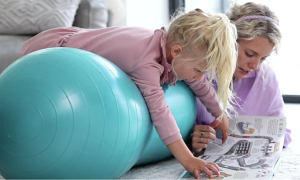
- Prone on your belly: Lying on the stomach over the peanut ball helps strengthen the shoulders, arms, and upper body while also supporting core activation and postural control.
Improving Balance, Coordination, and Body Awareness
Unlike sitting on a stable chair, the peanut ball requires children to actively control their bodies. As the ball moves, children learn to shift their weight, adjust their posture, react to movement, and maintain equilibrium.
The proprioceptive input provided through the peanut ball helps children develop body awareness, allowing them to better understand where their body is in space. Improved body awareness supports smoother, more coordinated movements and increased confidence during everyday activities.
These foundational skills help children safely navigate playground equipment, climb stairs, ride bicycles, run, jump, dress independently, and participate successfully in sports and physical education.
Developing Motor Planning (Praxis)
Motor planning, also called praxis, is the brain’s ability to plan, organize, and carry out unfamiliar movements.
Activities on the peanut ball encourage children to climb on and off safely, transition between positions, navigate obstacle courses, sequence multiple movements together, and solve movement challenges independently.
Strong motor planning skills support learning new playground equipment, sports, dressing skills, bike riding, and many daily activities.
Strengthening the Shoulders, Arms, and Hands
Many fine motor skills begin with having a strong and stable foundation.
When children lie on their stomachs over the peanut ball, they bear weight through their shoulders, arms, wrists, and hands, strengthening the muscles needed for upper body stability.
These foundational skills support handwriting, coloring, cutting with scissors, opening containers, manipulating small objects, dressing, and many classroom activities.
Glute Strengthening Activities
The peanut ball is also a great tool for targeting glute strength, which is important for posture, balance, and functional movement.
- Heel-to-glute curls: Have the child lie on their back with their heels on the peanut ball. Encourage them to bend their knees and bring their heels toward their glutes, then slowly extend back out. This strengthens the glutes and hamstrings.
- Pizza squishes: While lying on their back with feet on the ball, have the child press their feet into the ball as if they are “squishing a pizza.” This provides proprioceptive input while activating the glutes and core muscles.
Improving Bilateral Coordination and Crossing Midline
Many peanut ball activities naturally encourage children to use both sides of their bodies together while reaching across the midline.
These movements strengthen bilateral coordination and crossing midline, which are essential for handwriting, reading, cutting with scissors, dressing, catching and throwing, and riding a bicycle.
Supporting Visual Motor Skills
As children balance and move on the peanut ball, they also strengthen important visual skills.
Activities requiring them to track moving objects, reach for toys, judge distances, or catch a ball improve visual tracking, eye-hand coordination, visual motor integration, and visual attention.
These skills are essential for handwriting, reading, copying from the board, sports, puzzles, and everyday play.
Supporting Sensory Processing and Self-Regulation
The peanut ball provides meaningful sensory input through both the vestibular and proprioceptive systems.
The vestibular system helps children process movement, balance, head position, and spatial orientation. The proprioceptive system provides information about body position, muscle force, and movement.
The peanut ball is particularly effective for providing controlled linear vestibular input through gentle rocking, bouncing, and rolling. This type of movement is often organizing and calming for the nervous system and can help improve attention, postural control, and body awareness. Because the peanut ball is more stable than a traditional therapy ball, therapists can carefully grade movement to match each child’s individual sensory needs.
Throughout therapy sessions, occupational therapists may use the peanut ball before tabletop activities to prepare children for learning, incorporate it into obstacle courses to challenge motor skills, or use it during treatment to help children remain regulated while working on functional tasks.
Building Confidence
Every successful movement builds confidence. Whether a child balances independently for the first time, reaches farther than before, or successfully completes a challenging obstacle course, each accomplishment strengthens self-confidence along with physical skills. As children’s strength, coordination, and body awareness improve, they become more willing to try new activities and participate more independently at home, school, and in the community.