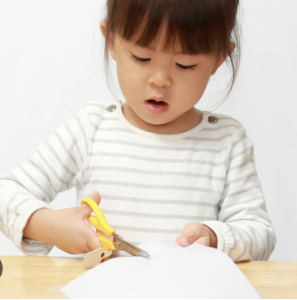
Scissor skills don’t just show up one day. They build over time through practice, coordination, and a lot of trial and error. What seems like a simple classroom task is actually a pretty complex skill. Kids are using hand strength, coordinating both hands, and relying on visual-motor skills all at once. When you understand how this skill develops, it becomes much easier to support them without expecting too much too soon.
Why Scissor Skills Matter
Before getting into the stages of scissor skills, it helps to understand why they are such a big deal.
- They help build the small muscles needed for pencil grasp
- They support the separation of the hand, which is key for precision
- They develop coordination between both hands
- They lay the foundation for writing and other school tasks
That simple open-and-close motion shows up later in handwriting more than you might expect.
Developmental Progression of Scissor Grasp
1. Early Exploration – 2 years old
At this stage, kids are basically trying to figure out what scissors even do.
- They use a whole-hand or fisted grasp
- They might use both hands to open and close
- Cutting looks like random snipping in all directions
- Movement comes from the shoulder and elbow, not the fingers
2. Developing Grasp and Control – 3 years old
Now things start to look a little more intentional, even if it’s still very early.
- Begins using a thumbs-up position
- One hand starts to take the lead
- They can snip across paper
- The helper hand starts to get involved
This is when both hands begin working together, which is a big step!
3. Functional Scissor Grasp – 3 to 4 years old
Here’s where you start to see a more organized pattern forming.
- Thumb goes in one loop, fingers in the other
- The rest of the hand helps stabilize
- They can cut forward instead of just snipping
- They can follow simple straight lines
This is the shift from random cutting to something that looks more controlled and purposeful.
4. Improved Precision and Coordination – 4 to 5 years old
This is when things really start coming together, and confidence starts to show.
- Kids can cut straight and curved lines
- They begin working on simple shapes like squares and triangles
- They learn to turn the paper instead of twisting their wrist
- Movement shifts more to the fingers
5. Mature Scissor Grasp – 5 to 6 years old
At this point, cutting looks smooth and efficient.
- Movements are controlled and consistent
- Kids can cut more complex shapes
- Hand dominance is clear
- There is less extra movement and more precision
This is when scissor skills are ready for most classroom tasks.
What They Cut Matters Too
It’s not just about how kids hold scissors. What they are cutting matters just as much.
- Straight lines
- Curved lines
- Corners and angles
- More detailed shapes
If a child is asked to cut something too difficult too soon, it can lead to frustration pretty quickly. When skills are built step by step, you can actually see confidence grow along the way.
OT Insight for Practice
From an occupational therapy perspective, there is a lot happening behind the scenes.
- Keeping the thumb pointing up
- Using different parts of the hand for stability and precision
- Having a stable wrist and arm
- Coordinating both hands together
When these pieces are not fully developed yet, kids might turn the scissors upside down, use both hands, or avoid cutting altogether.
When you watch your child practice cutting, you can actually see this whole process unfold. What starts as random snipping slowly turns into more controlled and purposeful cutting when the activity matches their skill level. It really does feel like leveling up. One day it’s just snips, the next day they’re staying on the line, and then suddenly they’re cutting shapes they didn’t expect they could manage yet.
It’s a good reminder that progress doesn’t come from pushing harder. It comes from giving kids the right challenge at the right time.
Scissor skills develop from exploration to control to precision to mastery. Sometimes all it takes is the right next step for everything to finally click.