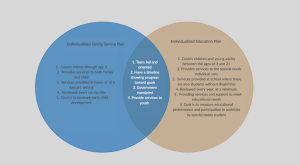
While they serve different age groups, both IFSPs and IEPs are created to help children receive the support they need to grow and succeed. These plans are part of special education services designed to support children’s development, learning, and participation in daily life.
What do IFSPs and IEPs have in Common?
Both IFSPs and IEPs:
- Are developed under IDEA (Individuals with Disabilities Education Act)
- Require parental consent and involvement
- Are created if a child qualifies for services
- Are reviewed and updated regularly
- Focus on supporting development and participation
What is an IFSP?
An IFSP (Individualized Family Service Plan) is for children from birth to age 3 who have developmental delays or disabilities.
Evaluations look at key areas of development:
- Physical (movement, vision, hearing)
- Communication (understanding and expressing language)
- Cognitive (learning and problem-solving)
- Social-emotional (relationships and emotions)
- Adaptive skills (feeding, dressing, routines)
A key feature of an IFSP is that it supports the whole family. Services are often provided in natural environments such as the home or daycare.
Services may include:
- Occupational therapy
- Physical therapy
- Speech therapy
- Special instruction
- Family support and training
What is an IEP?
An IEP (Individualized Education Program) is for children ages 3 through 21 who qualify for school-based special education services.
It focuses on a child’s educational performance, including:
- Academic skills (reading, writing, math)
- Communication
- Motor skills
- Social-emotional development
- Functional and self-care skills
Evaluations may include classroom observations, assessments, and input from parents and teachers.
Services may include:
- Occupational therapy
- Physical therapy
- Speech-language therapy
- Counseling services
- Special education instruction
- Classroom supports and accommodations
Transition from IFSP to IEP
Around age 3, children receiving Early Intervention services may transition to school-based services. If eligible, the school team develops an IEP to continue supporting the child in an educational setting.
Parent Rights
Parents are key members of the team and have the right to:
- Participate in meetings
- Ask questions and review results
- Consent to or decline services
- Request evaluations
- Advocate for their child’s needs
Role of Occupational Therapy
Occupational therapists may be part of both IFSP and IEP teams. OT helps children build skills for daily life, including:
- Play and engagement
- Fine motor and handwriting skills
- Self-care tasks
- Sensory regulation
- Participation in school routines
What Happens After Age 21?
In most states, eligibility for special education services through an IEP ends when a student reaches the maximum age allowed under state law or graduates with a regular high school diploma.
However, support does not necessarily end at age 21. As students transition into adulthood, they may be eligible for services and supports through community agencies, vocational rehabilitation programs, colleges and universities, independent living programs, and other adult service providers.
Transition planning is an important part of the IEP process and is designed to help students prepare for life after high school, including education, employment, and independent living.
Occupational therapists can play a role in transition planning by helping students develop skills needed for employment, independent living, community participation, and post-secondary education.
Key Takeaway
IFSPs and IEPs are different in structure, but both exist to support children in reaching their developmental and educational potential. Understanding them can help families feel more confident navigating services and advocating for their child