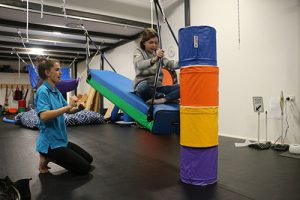
Astronaut training is a specialized sensory-based occupational therapy treatment protocol designed to target difficulties such as sensory processing, postural control, balance, and coordination by integrating the body’s vestibular, visual, and auditory systems.
There are 3 key components of astronaut training, so let’s take a closer look at each of them!
- Vestibular Activation
- This component of the treatment protocol involves providing specific vestibular input to activate the components of the child’s vestibular receptors in multiple planes.
- This may be done through:
- Rotary spinning, such as spinning on an astronaut board, rotary movement on swings, and orbiting activities
- Linear movement, such as gliding, scooter board movement, and linear bouncing
- Changes in head position, such as head tilts while moving
- Inversion (shifting the head upside down), such as somersault-type patterns
- Controlled acceleration/deceleration, such as rolling patterns
- Movement through different planes
- This movement will be completed with intentional rhythm, sequence, timing, and grading to ensure sensory input is not random.
- Auditory Input / Therapeutic Listening Component
- This component is the “sound activated” portion of the astronaut training protocol
- During this portion, the child will listen to specifically selected music while engaging in movement to help integrate the body’s vestibular and auditory systems.
- Therapeutic listening recordings will help to:
- Regulate arousal
- Support timing/rhythm
- Organize vestibular processing
- Improve auditory discrimination
- Recordings are often chosen based on the child’s:
- Arousal level
- Sensory profile
- Modulation needs
- Vestibular reactivity
- Emotional regulation needs
- Visual/Ocular Motor Training
- This component of the treatment protocol focuses on strengthening functional eye movements so the child’s eyes can remain stable while the body is moving. These eye movements include:
- Vestibulo-ocular reflex (VOR)
- Visual tracking
- Saccades
- Smooth pursuits
- Eye-head coordination
- Visual stabilization
- This portion of the protocol is completed after the child engages in vestibular activation, and includes:
- Visual tracking activities, such as following flashlight targets and tracking objects
- Eye movement exercises
- Visual fixation tasks, such as looking while spinning and eye movements after rotary activity
- Visual convergence/divergence tasks
- Near/far point tracking
- Strengthening ocular motor control will support the child’s reading, copying, attention, coordination, balance, and motor planning.
Additional Components:
- During the use of this treatment protocol the therapist will observe the child for signs of Post Rotary Nystagmus, which is back and forth eye movement that occurs immediately after the body is spun and then stopped.
- Observing the presence/abscene of PRN, as well as the duration and symmetry of the eye movements will provide the therapist with information such as the child’s vestibular processing, arousal, and neurological organization.
- The therapist will also constantly monitor the child’s regulation and arousal state throughout the use of the treatment protocol. The use of astronaut training should not dysregulate the child excessively.
- This treatment protocol strongly emphasizes the use of timing and rhythm, as it has been shown that the nervous system organizes better when movement and sound are rhythmically paired.
- Astronaut training involves a sequential neurological progression, designed to integrate the child’s vestibular, visual, and auditory systems. This progression follows:
- Preparation
- Vestibular activation
- Ocular motor integration
- Functional integration
- Regulation/recovery
Astronaut training can only be performed by therapists that are trained in the protocol, and it requires careful grading, observation, knowledge of vestibular processing, and understanding of sensory integration.
If you feel your child could benefit from this treatment protocol, Building Blocks Occupational Therapy is here to help!
Resources
Astronaut training – courses. Vital Links. (2026, January 29). https://vitallinks.com/course/astronaut-training/
Astronaut program® for sensory support. MoveAbout Therapy Services. (n.d.). https://www.moveabout.com.au/astronaut-program/