Note: These are not all possible milestones. These are just some important developmental milestones and the ages are general.
Fine motor
- Reach with one arm and then bilateral reach (reaching with both arms) between 4-6 months
- Transfer an object from hand to hand at midline around 5 to 7 months
- Raking grasp around 6 months
- Radial palmar grasp around 6-8 months
- Radial digital grasp around 8-12 months
- Immature pincer around 10 months
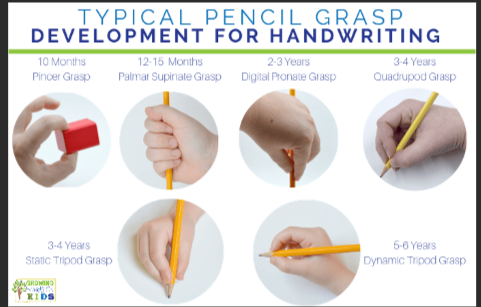
- Grasp/pinch patterns:
- Point with index finger around 12 months
- True pincer around 12 months of age
- Order of crayon/pencil writing grasps:
- Palmar supinate 12-18 months
- Digital pronate 2-3 years
- Static tripod at 3-4 years
- Dynamic tripod (lateral tripod) around 5 years
- Preschool skills
- In-hand manipulation skills (shift, rotation, translation) without stabilization around 4-5 years.
- Open web space between 4-6 years of age
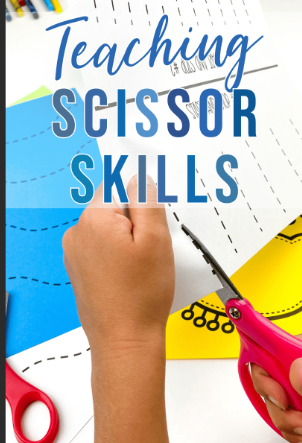 Scissor skill progression
- Using two hands to cut at 1.5-2 years
- Open and close scissors to cut play dough around 2-2.5 years
- Snipping at edge of paper around 2.5-3 years old
- Cutting across in a generally straight manner or on a straight line around 3-3.5 years of age
- Cutting on a curved line and circles around 4 years old
- Cutting complex shapes like a star around 5-6 years old
Gross motor skills:
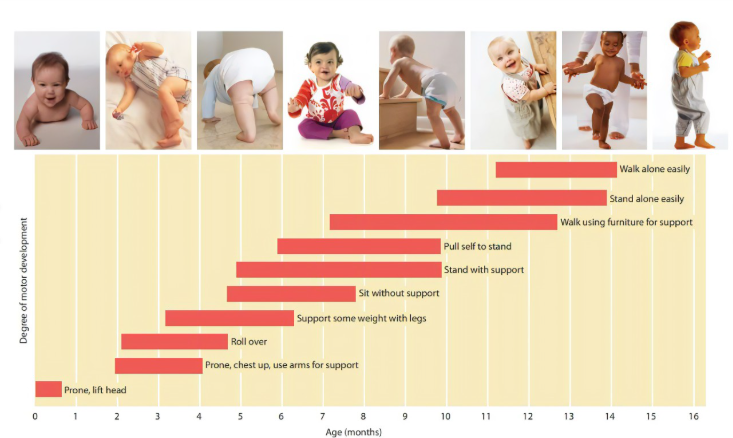
- Rolling each direction around 6 months of age
- Push-up on all fours around 7-9 months
- Side sit around 7-9 months
- Sit independently around 6 months when supported by both hands and unsupported by their hands around 8-9 months.
- Creep and crawl around 6-10 months of age
- ½ kneel around 9-10 months
- Pull to stand/ Cruise around 9 to 12 months
- Walking around 9-18 months
- Running around 18 to 24 months
- Jump with 2 feet around 2 years old
- Galloping around 2-3 years old
- Hop on 1 foot around 3-4 years old
- Pump swing around 3-5 years old
- Stand on 1 foot around 3-5 years old
- Skipping around 5-6 years old
- Hold supine flexion and prone extension full for 30 seconds (age 5)
- Ride a bike two-wheeler independently (5-7 years old)
- Infant reflexes
- Moro: startle reflex that is present at birth and integrates between 2 to 4 months of age
- Rooting: this reflex helps the baby find the nipple and is present at birth and integrates between 3 to 6 months
- Palmar: when the baby grasps anything put in their palm, occurs at birth and integrates between 3 to 6 months
- TLR: this affects the baby’s posture depending on head position, it is present at birth and typically integrates between 3 to 6 months.
- Spinal Galant reflex: this is when the baby’s back arches when the spine is stroked; it is present at birth and usually integrates between 3-9 months.
- ASTNR: where the baby extends the extremity on the side, they are looking and flexes the limbs on the opposite side. This develops between 1 to 4 months and integrates between 6 to 9 months.
- STNR: helps the baby move their top half and bottom half separately and usually integrates between 9 to 11 months
- Infant in prone:
- Can lift head around 3 months of age
- Prop on elbows around 4-6 months
- Prop on hands around 5-6 months
Visual Perceptual Motor (VPM)
- Progression of towering blocks:
- Around 7 to 9 months babies show interest in 1” blocks by picking them up and banging them together
- Around 11 to 12 months a baby may try to stack one block on top of another, but may not have the proper motor planning to do so
- Around 12 to 16 months, a child should be able to make a two block tower successfully
- Around 16 to 18 months, a child should be able to create a three block tower successful
- Around 18 to 22 months, a child should be able to stack four blocks successfully
- Around 22 to 24 months, a child should be able to stack six blocks successfully
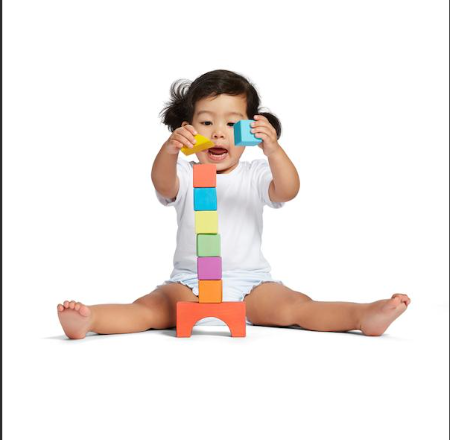
- Around 28 to 31 months, a child should be able to stack eight block successfully
- Around 32 to 36 months, a child should be able to stack nine blocks successfully
- After three years of age, the child should be able to stack 10 blocks successfully
- Completing a puzzle
- A child should be able to complete a three-piece puzzle between 6 to 18 months
- A child should be able to complete a four piece puzzle between 26 to 36 months
- 3 to 4-year-olds will likely be able to complete 8 to 10 piece puzzles
- 4 to 5-year-olds can take on 12 to 24 piece puzzles
- 5 to 6-year-olds can do 24 to 48 piece puzzles
- 6 to 7-year-olds can do 50 piece to 100 piece puzzles
- 7 to 8-year-olds can do 100 to 200 piece puzzles
- And around 8 years of age, the child can do more than 200 piece puzzles
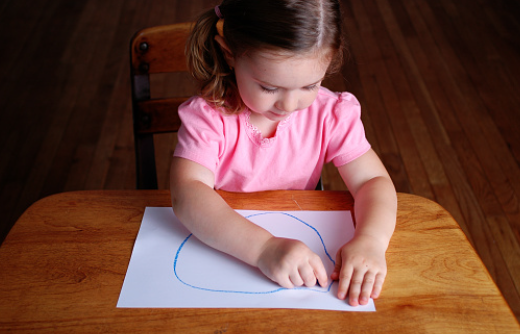
- Writing
- A child may imitate scribbling between 12 to 18 months
- A child may imitate vertical lines around the age of 2
- A child may imitate a circle around the age of 3
- A child should be able to copy a circle or vertical/horizontal lines between the ages of 2.5 to 3
- A child may imitate and copy letters with horizontal and vertical lines (H,T,L,E) around the age of 3-4
- A child can likely imitate and copy diagonal lines (like a triangle shape) and letters with diagonal lines (X, K, R) around the age of 5.
- A child is typically able to trace letters and name, copy name, write name around the age of 4
- Drawing a person
- 1-3 body parts at 3 years old
- 4-7 body parts at 4 years old
- 8+ parts around 5
ADL
- 1-2 years
- Attempting to brush teeth
- Knowing where familiar items are kept
- Removing own shoes and socks
- Cooperating with dressing by extending an arm or leg/ pushes arms and legs through
 2-3 years
- Using toilet with assistance and having daytime control
-
- Pulls down pants
- Finds armholes in pullovers
- Removes jackets if unfastened
- Unbuttoning large buttons
- Puts on a front button shirt
- Distinguishing between urination and bowel movements, and names them correctly
- Using a napkin to wipe face and hands
- Feeding self simple meals using a fork or spoon
- Taking socks and shoes off
- Knowing where familiar items are kept
- Attempting to brush teeth
- 3-4 years
- Feeding self without difficulty
- Buttons large buttons
- Puts on pullover
- Zips and unzips (except to get zipper started)
- Snaps buttons
- Independently putting things away
- Using a napkin to wipe face and hands
- Toileting independently
- Dressing and undressing self (only requiring assistance with laces, buttons, and other fasteners in awkward places)
- Brushing teeth independently
- 4-5
- Identifies front and back of clothing
- Zips jacket
- 5 ish-
- Dresses independently
- 5-6+
- Ties shoes
- Toileting
- May awaken at night and cry to be changed 1.5 years
- Child may indicate wet pants 1.5 years
- Only has an occasional accident 22 months
- Climbs on to toilet by self 2.5 years
- Controls bladder up to 5 hours 2.5 years
- Attempts to wipe self, not successful 3.5 years
- Stays dry at night 4 years
- Toilet without assistance 4.5-5 years
Resources:
Capable of completing puzzles with three or four pieces (26-36 months). Parenting Counts. (n.d.). https://www.parentingcounts.org/capable-of-completing-puzzles-with-three-or-four-pieces-26-36-months/#:~:text=28%2D36%20Months
Ellis, R. R. (2023, July). What developmental milestones will my baby reach in the first year of life?. WebMD. https://www.webmd.com/parenting/baby/baby-first-year-milestones
Hogan, L. (2024, February). The sensorimotor stage: What it is, its substages, and related activities. WebMD. https://www.webmd.com/parenting/baby/what-is-sensorimotor-stage
Shelov, S. P. (Editor-in-Chief). (2004). Caring for Your Baby and Young Child: Birth to Age 5. The American Association of Pediatrics. Revised edition. New York: Bantam Books
Shop sale new arrivals adult puzzles Afrikaans products children’s puzzles classroom Resources Educational Products Educational Toys Exploration & Science Family Games Gross Motor & Outdoor Play Music polarb viga toys. RGS Group. (n.d.-a). https://www.rgsgroup.co.za/puzzle-age-guide/
Teaford, P. (2004). Help 0-3 checklist (2nd ed.). Shine Early Learning. https://shineearly.store/products/help-3-6-checklist-2nd-ed
Wood, V. W. (2023, October 19). Grasp patterns. The OT Toolbox. https://www.theottoolbox.com/grasp-patterns/