• Skip to primary navigation
  • Skip to main content
  • Skip to primary sidebar
  • Home
  • Meet Our Team
  • About OT
  • Evaluations & Services
  • Testimonials
  • Blog
  • Books
    • Email
    • Facebook
    • Instagram
    • Phone

Building Blocks Pediatric Occupational Therapy Services

Fairfield Connecticut Occupational Therapist

203-341-0178
943 Post Rd E Suite A
Westport, CT 06880
bbpedot@yahoo.com
  • Home
  • Meet Our Team
  • About OT
  • Evaluations & Services
  • Books
  • Testimonials
  • Blog
    • Email
    • Facebook
    • Instagram
    • Phone

The Baby Blueprint: Exploring Developmental Milestones

May 3, 2026 By admin

Your baby grows so much within the first year and every little movement is a big win! Exploring the pediatric developmental milestones will provide you with a guideline to monitor your baby’s development. So let’s take a look at the fine and gross motor developmental milestones your baby will experience in their first year of life!
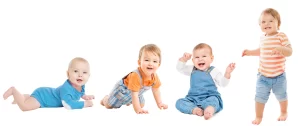
Let’s start by reviewing the difference between fine and gross motor:

  • Fine motor: The movement of small muscle groups (i.e. fingers, wrists and hands)
  • Gross motor: The movement of large muscle groups (i.e. coordination of arms, legs, and torso)

Now let’s break these milestones down month by month:

1 month

Fine motor:

  • Baby’s hands are fisted near their face

Gross motor:

  • Baby will start to raise their chin when lying on their tummy
  • They are able to turn their head when lying on their back

2 months

Fine motor:

  • Baby can bring their hands to the middle of their body
  • They will start to open their hands briefly
  • You will see them holding their hands together too

Gross motor:

  • Baby will start to lift their chest up when lying on their tummy
  • Baby is now able to move both their arms and legs
  • Their head will bob when you hold them in a sitting position

3 months

Fine motor:

  • Baby will start to bring their hands to their mouth
  • They will continue to open their hands more
  • They will start to bat at objects near them

Gross motor:

  • Baby will prop themselves up on their forearms when lying on their tummy
  • You will see your baby start to roll on their side

4 months

Fine motor:

  • Baby will begin reaching for objects
  • They bring their hands and objects to their mouth
  • Their hands will be open most of the time

Gross motor:

  • Your baby can now hold their head steady without support
  • They will start to roll from their tummy to their back
  • You will see them push onto their elbows and forearms when lying on their tummy

5 months

Fine motor:

  • Baby will grasp objects with their palm
  • They can transfer objects from their hand to their mouth, and back
  • They can reach and grab dangling rings

Gross motor:

  • Baby can sit with your support at their pelvis
  • Baby can now roll from their back to their tummy
  • Your baby will develop the protective reflex to put their arms out front when falling

6 months 

Fine motor:

  • Baby will move objects from one hand to the other
  • They can hold two objects simultaneously
  • They will start to feed themselves easy foods (i.e. crackers)

Gross motor:

  • Baby will bear weight through their hands when on their tummy
  • They can sit unsupported for brief periods of time
  • You will see them lean on their hands for support when sitting

7 months 

Fine motor:

  • Baby will start to grasp objects using the side of their palm near their thumb and their first few fingers on that side

Gross motor:

  • Your baby will bounce when you hold them
  • They can now sit steadily without support
  • They develop the next protective reflex of putting their arms to the side when falling

8 months

Fine motor:

  • Baby can bang a spoon after a demonstration
  • They can hold their own bottle
  • Baby will use a scissor grasp to pick up cubes

Gross motor:

  • Baby can get into sitting by themselves
  • They will start to use their arms to move themselves forward, but their legs and tummy will remain on the ground
  • They can pull themselves into kneeling

9 months

Fine motor:

  • Baby can now play with toys while sitting up
  • They will use fingers to “rake” food towards them
  • They will grasp with their thumb, index, and middle fingers

Gross motor:

  • Baby will start to “stand” on feet and hands
  • They can pull themselves to stand
  • They will start to “bear” walk using all four limbs

10 months

Fine motor:

  • Baby will have a clumsy release of cubes
  • They will grasp objects with the pads of their thumb and index finger
  • They can now use their index finger to point

Gross motor:

  • Your baby will be cruising around holding on to furniture with both hands
  • They can stand while you hold one of their hands
  • They can now walk while you hold both of their hands

11 months

Fine motor:

  • Your baby can now throw objects (watch out!)
  • They can stir using a spoon

Gross motor:

  • Baby will pivot while sitting
  • They can now cruise around using one hand to hold on to furniture
  • They can now walk while you hold one of their hands

12 months

Fine motor:

  • Baby will grasp objects using the tips of their thumb and index finger
  • They can finger feed themselves by pinching food with their thumb and index finger
  • They can hold a crayon and scribble after a demonstration

Gross motor:

  • Baby can now stand well with their legs apart and arms outstretched
  • They develop the next protective reflex of putting their arms back when falling
  • They are starting to take some steps independently

Filed Under: Uncategorized

Primary Sidebar

Latest Posts

My Journey Into Occupational Therapy

Sensory Diets..What Are They and How Can They Help?

Therapeutic Listening: A Different Way to Support Your Child’s Development

Why Crawling is Important

Like Us on Facebook

Building Blocks Pediatric Occupational Therapy Services, LLC

Archives

Categories

More About Us

  • Home
  • Meet Our Team
  • About Occupational Therapy
  • Evaluations & Services
  • Contact Us
  • Blog
🌈 SOCIAL-EMOTIONAL TOOLBOX FOR PARENTS, TEACHER 🌈 SOCIAL-EMOTIONAL TOOLBOX FOR PARENTS, TEACHERS & THERAPISTS 🌈

Occupational therapy is personal to me. I truly love what I do, I love the children and families I work with, and I want to help as many people as I can. ❤️

After 25 years as an occupational therapist, I’ve learned there isn’t one strategy that works for every child or every moment. That’s why I created this Social-Emotional Handout & Toolbox for parents, teachers, therapists, caregivers, and anyone supporting children.

It’s filled with quick, practical tools you can reach for in the moment—recognizing body signals, emotional regulation, anxiety and worry, frustration and anger, transitions, flexible thinking, friendships, sensory strategies, movement, calming tools, and repairing after a hard moment.

My hope is that you save it, share it, and use it when a child needs a little extra support. Sometimes having the right tool at the right time can make all the difference. 💛

Please reach out anytime with questions, for additional resources, or if you’d like me to become part of your child’s team. Helping children, families, teachers, and fellow therapists is truly why I love what I do. 🌈

#PediatricOT #SocialEmotionalSkills #TeacherTools #TherapyTools #Explore
PRIMITIVE REFLEXES: NOW WITH VISUALS! ✨ My orig PRIMITIVE REFLEXES: NOW WITH VISUALS! ✨

My original Primitive Reflexes Parent Guide received so much attention and such wonderful feedback! 💛 One of the biggest requests was: “Can you show us pictures of the exercises?”

So here you go! 🌈

I created visual examples to go along with the home strategies so parents can more easily see what each movement should look like and feel more confident practicing them at home.

Primitive reflexes can play an important role in the foundations for movement, posture, coordination, balance, body awareness, attention, regulation, handwriting, motor planning, and everyday functional skills.

This guide covers:
🌟 Moro
🌟 ATNR
🌟 STNR
🌟 TLR
🌟 Spinal Galant
🌟 Palmar Grasp

You’ll also find simple home activities like cross-crawl, cat-cow, bird-dog, log rolls, starfish movements, animal walks, hand-strengthening activities, deep pressure, and breathing—now with pictures to provide a clear visual! 📸

The goal isn’t perfection. Keep the movements slow, playful, comfortable, and consistent. Even a short daily movement routine can be a great way to support foundational skills through play. 💪🌈

📚 For more information: Primitive Reflexes: Retained Reflexes and Integration Techniques by Justine Bedocs, OTR/L, available on Amazon.

💾 SAVE this guide to use at home and 📤 SHARE it with a parent, teacher, or therapist who may find the visuals helpful!

Primitive reflexes are only one piece of a child’s development. Individual concerns should always be evaluated by a qualified professional.

#PrimitiveReflexes #PediatricOT #OccupationalTherapy #HomeProgram #explore
🧡 WHY BALANCE ACTIVITIES MATTER! Balance is SO 🧡 WHY BALANCE ACTIVITIES MATTER!

Balance is SO much more than just standing without falling! Balance activities help build the underlying skills kids need to move, learn, play, and feel confident in their bodies. 🌈

Working on balance helps develop:

✨ Core strength & stability
✨ Postural control
✨ Coordination
✨ Motor planning
✨ Body awareness & proprioception
✨ Vestibular processing
✨ Bilateral coordination
✨ Protective reactions
✨ Focus & attention
✨ Confidence with movement

And when balance improves, we often see improvements in everyday skills too—running, jumping, climbing, navigating playgrounds, sitting upright for learning, participating in sports, dressing, and moving safely through the environment.

Balance boards are one of my favorite OT tools because there are SO many ways to use them—rocking, wobbling, squatting, reaching, playing games, or even using them during tummy time!

💙 Better balance → stronger bodies → more confident kids!

#Balance #Explore #OccupationalTherapy #PediatricOT #MovePlayGrow
🧡 THE PEANUT BALL — SUCH A GREAT BANG FOR YOU 🧡 THE PEANUT BALL — SUCH A GREAT BANG FOR YOUR BUCK!

I truly love a peanut ball for home therapy. For around $20, there are so many ways to use it while working on important underlying skills through play.

Sit, bounce, stretch, do pizza squishes, work on puzzles, strengthen the core, build balance, improve body awareness, motor planning and so much more.

It’s simple, affordable, fun, and one of those therapy tools that can grow with your child. 🌈

One inexpensive tool. So many possibilities.

Always supervise and choose activities that are appropriate for your child.

#PediatricOT #OccupationalTherapy #PeanutBall #ParentTips #Explore
12 weeks of growth, learning, laughter, and memori 12 weeks of growth, learning, laughter, and memories I’ll carry with me forever 🤍

I’m so grateful for my Level II fieldwork at Building Blocks Pediatric Occupational Therapy Services and for everything this experience has taught me about pediatric OT and the therapist I hope to become.

A huge thank you to Justine for an amazing 12 weeks. Thank you for your guidance, encouragement, and for showing me what it means to truly love and care for every child you work with. I’m so lucky I got to learn from you! 🤍

And to all of the families who trusted me with your children, thank you for allowing me to be a small part of their growth and progress. I’ll always be grateful for the memories and connections I made. 🫶🏼

I shared a little more about my journey and fieldwork experience on the blog! Link in bio ✨

#PediatricOT #OccupationalTherapy #OTStudent #ᴇxᴘʟᴏʀᴇᴘᴀɢᴇ 
@lexiberroa @justinecarol77 @building_blocks_stories
✨ PRIMITIVE REFLEXES: A SIMPLE GUIDE FOR PARENTS ✨ PRIMITIVE REFLEXES: A SIMPLE GUIDE FOR PARENTS ✨

Primitive reflexes are automatic movements babies are born with that support early development. As children grow, these reflexes should naturally fade as more controlled movement takes over. 🧠🌈

If they remain active, you may notice challenges with:

⭐ Balance & coordination
⭐ Posture & core strength
⭐ Crossing midline
⭐ Handwriting & fine motor skills
⭐ Body awareness
⭐ Attention & self-regulation

Common reflexes include Moro, ATNR, STNR, TLR, Spinal Galant, and Palmar Grasp.

🏠 AT-HOME SUPPORT IDEAS

Try simple daily movement play:

🌟 Cross-crawl
🌟 Cat-cow
🌟 Bear & crab walks
🌟 Starfish or snow angels
🌟 Bird-dog
🌟 Log rolls
🌟 Theraputty or clothespins
🌟 Deep pressure hugs & breathing

Just 10–12 minutes a day can support foundational development through movement and play.

The goal is to build strong foundations for play, learning, and independence 💪🌈

📚 Learn more in Primitive Reflexes: Retained Reflexes and Integration Techniques by Justine Bedocs, OTR/L (Amazon)

💾 Save & 📤 share with someone who may find this helpful

Primitive reflexes are only one part of development. Concerns should be evaluated by a qualified professional.

#PrimitiveReflexes #PediatricOT #OccupationalTherapy #ParentTips
📚💙 “What Is OT? And What Will I Do There?”

Today I had the sweetest little reading buddy, Stella, help me share my children’s book about occupational therapy! 🥰 And she gave it TWO thumbs up! 👍👍

The main character is my son, Drew, who takes kids along with him to OT and shows them that therapy can be a place to play, learn, practice, grow, and build confidence.

Through Drew’s story, children learn about some of the many things we work on in OT:

✨ Fine & gross motor skills
✨ Visual-motor skills
✨ Dressing & daily living skills
✨ Feeding skills
✨ Sensory processing
✨ Body awareness & motor planning
✨ Executive functioning
✨ Interoception — understanding what our bodies are telling us
✨ Social-emotional skills
✨ Self-regulation & independence

My favorite message of all:

💙 OT is all about helping children become their best, most independent selves.

At OT, children learn:
I am strong. I am capable. And I am ready to do amazing things. 🌟

And according to Stella… it’s definitely a two-thumbs-up read! 👍👍📖

#OccupationalTherapy #PediatricOT #BuildingBlocksPediatricOT #explore
What exactly is a sensory diet? 🤔 If you’ve What exactly is a sensory diet? 🤔

If you’ve ever heard the term but weren’t quite sure what it meant, this post is for you! A sensory diet is so much more than a list of activities, it’s a personalized approach to helping children feel regulated, confident, and ready to participate in everyday life.

This carousel covers the basics, but there’s so much more to learn!

✨ Head to our blog to read the full guide, where we cover:
• What a sensory diet is
• Who can benefit
• Signs your child may benefit from one
• What a sensory diet looks like in everyday life
• And examples of activities for all 8 sensory systems

🔗 Visit the link in our bio to read the full blog!

💙 Save this post for later and share it with someone who might find it helpful.

#OccupationalTherapy #PediatricOT #SensoryProcessing #ᴇxᴘʟᴏʀᴇᴘᴀɢᴇ #ParentEducation
Follow on Instagram

Copyright © 2026 · BBPOTS, LLC · Site Design by Little Blue Deer
Privacy Policy