What are fine motor skills?
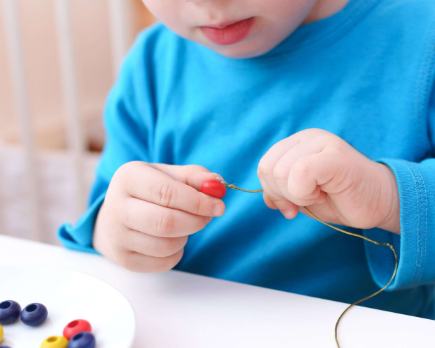
Fine motor skills are precise movements we make with our hands and fingers to complete tasks. They are needed for every person to be able to participate in everyday activities like school activities such as writing, cutting and working with their hands for small tasks. Fine motor skills are also needed for dressing (being able to work fasteners), playing, etc. There are also a variety of gasp patterns needed to complete fine motor tasks. In addition, fine motor abilities also may add to a child’s social, cognitive, and logical thinking. To properly use fine motor skills, one must be able to motor plan and coordinate, in addition to having hand strength, sensation, and dexterity.
What do fine motor skills encompass?
Bilateral coordination: This is the ability to use both hands at the same time or using one hand to stabilize while the other one manipulates. Examples of this skill include lining up a zipper with both hands then stabilize with one while the other pulls up the zipper. Or a hand may stabilize a paper while the other hand writes. Using both hands activate both hemispheres of the brain, which improves cognition.
Gross gasp: This is when all fingers are shut around an object. An example if this is holding a water bottle. This is an important to build coordination and hand strength for fine motor activities.
Pincer grasp: Being able to pick up small objects with thumb and index finger.
Tripod grasp: Being able to connect the thumb to the pointer and middle finger when grasping and manipulating items. This is the preferred way to hold a pencil.
Writing grasps: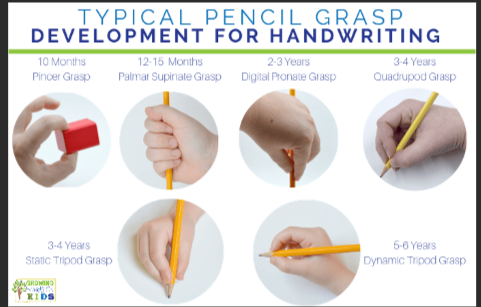
- Palmar supinate usually develops at 12-18 months and it is a whole hand grasp on objects.
- Digital pronate: This occurs around 2-3 years old and uses all the fingers and the thumb to point down towards base of writing tool and the wrist is turned down and away from body.
- Static Tripod: Occurs around the ages of 3-4 and the pencil is held properly between the thumb and index finger, resting on the middle finger with other two fingers tucked. The whole arm, elbow shoulder, and wrist moves when writing at this point.
- Dynamic tripod: The same position as static tripod, however, only the fingers move, and this is the ideal writing position.
Open web space: The space between the thumb and index finger created when touching the thumb to the index finger and is ideal for writing, manipulating objects, and working fasteners.
Separation of hand: This separates the precision side of the hand which includes the thumb, pointer and middle finger used for writing, from the power side of your hand which is the pinkie and ring finger. Separation of the hand is also useful for scissor skills and other activities like tying shoes.
Hand strength: This is important to be able to manipulate objects and have endurance for fine motor tasks. Examples of this include opening and closing a Ziplock, manipulating fasteners, and being able to write for extended periods of time.
Hand-eye coordination: Being able to coordinate visual information with hand movements. This could be threading a needle, playing an instrument, cutting things out, and/or writing.
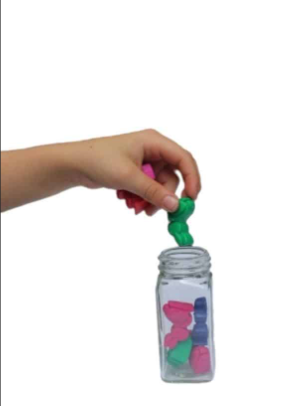
In hand manipulation: Being able to manipulate objects within your own hand. This skill includes 3 components.
- Shift: This is moving objects just with the pads of your fingers. This could be buttoning or using a zipper with just fingertips.
- Rotation: Rotating an object in your hand such as rotating a pencil to use the eraser.
- Translation: Using fingers to move small items from palm to hand, such as, holding coins in your palm and manipulating within your hand to bring the coin to fingertips to put it in a piggy bank.
Tasks that require fine motor skills:
- Picking up small objects
- Holding a writing utensil or tweezers

- Fastening clothes
- Writing and drawing
- Self-care tasks (flossing, brushing teeth, coordinating utensils during meals, etc)
- Arts and crafts
- Typing
What areas do occupational therapists target to help improve these skills?
- Sensory integration: These activities incorporate sensory to work on proprioception, motor planning and tactile discrimination which is necessary for development of fine motor skills.
- Therapeutic activities: Purposeful activities to work on control, grasps, hand strength and coordination.
- Adaptive strategies: Occupational therapists may recommend pencil grips, slant boards, weighted/vibrating/built-up writing utensils, or other adaptive utensils, assistive technologies or ergonomic tools.
- Handwriting skills: Occupational therapists often work with children through writing tools to improve legibility, fluency, and speed.
How to know if your child may need help with fine motor skills
Children start developing fine motor skills as a baby. With pincer grasp usually developing around 9-12 months and writing, dressing, strength, coordination and hand manipulation skills develop over time, not expected to be done well until around kindergarten age. However, some fine motor skills such as using utensils and tying shoes are expected later between ages 6-8. All these skills are being developed and may come at different times. If your child is really struggling in school or at home with fine motor skills, consult with your doctor or an occupational therapist.
In conclusion, fine motor skills are something we develop from infancy to elementary age, and they are necessary for many tasks in everyday life. There are many ways to progress these skills at home, or in a clinic depending on the need. Fine motor skills do not only help with motor activities, but they also boost cognition and social aspects as well.
References:
Fine Motor skills. Cleveland Clinic. (2025b, March 19). https://my.clevelandclinic.org/health/articles/25235-fine-motor-skills
Hwang, N.-H., Chen, S.-S., Pai, T.-W., Ko, M. H.-J., Yu, Y.-L., & Chen, H.-J. (2025). Automatic Assessment of Fine Motor Development in children through hand-drawn shape images. Pediatrics & Neonatology. https://doi.org/10.1016/j.pedneo.2025.04.001
The OT’s Guide to Fine Motor Skills. The OT Toolbox. (2024, September 13). https://www.theottoolbox.com/fine-motor-skills/