Have you ever wondered how your baby knows how to suck during feeding right from birth? This is an example of a primitive reflex that babies are born with. Let’s take a look at 10 essential newborn reflexes that are important for survival, protection, and neurological development!
1. Moro reflex
What is it?
Also known as the “startle reflex,” this is an automatic response to a loud sound or sudden movement. When this reflex occurs, you will see your baby’s arms jump out and then tuck back in.
Why is it important?
This reflex helps your baby to feel safe in the world and develop their fight or flight response.
2. Rooting reflex
What is it?
This reflex helps your baby to latch for feeding. When your baby is touched on the cheek, they will turn their head, open their mouth, and extend their tongue.
Why is it important?
This reflex helps babies find their food and learn how to eat.
3. Sucking reflex
What is it?
This reflex occurs when something touches the roof of your baby’s mouth. When this occurs, the baby will start to suck all on their own.
Why is it important?
This reflex helps your baby to eat and drink. This reflex is not fully developed until 36 weeks of gustation, which is why babies born prematurely may have difficulty with sucking.
4. Palmar grasp reflex
What is it?
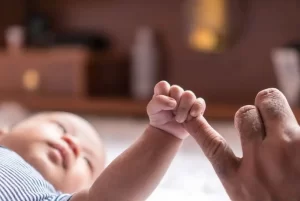
When you touch your baby’s palm their fingers will naturally wrap around yours and hold tightly.
Why is it important?
This reflex helps your baby to develop their grip and explore the world around them through touch.
5. Plantar grasp reflex
What is it?
When you touch the sole of your baby’s foot their toes will naturally curl down.
Why is it important?
This reflex helps your baby feel the ground and get ready to stand!
6. Asymmetrical Tonic Neck reflex (ATNR)
What is it?
Also known as the “fencing reflex,” this occurs when your baby turns their head to the side. When they turn their head, their arm and leg on that side will extend, and the opposite arm and leg will bend.
Why is it important?
This reflex will help your baby build muscle tone and hand-eye coordination.
7. Symmetrical tonic neck reflex (STNR)
What is it?
Also known as the “crawling reflex,” this is an involuntary movement pattern that helps coordinate your baby’s arms and legs to help them learn to crawl.
Why is it important?
This reflex will help your baby to move from lying down to their hands and knees, and support them as they learn to crawl.
8. Spinal Galant reflex
What is it?
This reflex will cause your baby to curve their hips toward the side when their back is stroked.
Why is it important?
This reflex helps with the birthing process and also aids in the development of your baby’s hip range of motion for future crawling.
9. Babinski Reflex
What is it?
This reflex occurs when you stroke the bottom of your baby’s foot. Their big toe will lift and their other toes will fan out.
Why is it important?
This reflex is important to get your baby’s feet ready for walking and learn how to feel the ground.
10. Stepping/walking reflex
What is it?
This reflex occurs when your baby’s feet touch a flat surface and will cause them to move their legs as if they were taking little steps.
Why is it important?
This reflex is important for future walking!
Resources
Newborn reflexes. Stanford Medicine Children’s Health. (n.d.). https://www.stanfordchildrens.org/en/topic/default?id=newborn-reflexes-90-P02630
What is the asymmetrical tonic neck reflex (ATNR) in babies?. Cleveland Clinic. (2026, April 1). https://my.clevelandclinic.org/health/articles/asymmetrical-tonic-neck-reflex
What is the babinski sign?. Cleveland Clinic. (2026b, April 20). https://my.clevelandclinic.org/health/articles/babinski-reflex-plantar-reflex
What is the symmetrical tonic neck reflex (STNR)?. Cleveland Clinic. (2026b, April 1). https://my.clevelandclinic.org/health/articles/symmetrical-tonic-neck-reflex